What matters most when selecting a wireless heat pump thermostat is reliable Wi‑Fi connectivity, compatibility with heat pump systems, and simple setup. This guide highlights five suitable options for American homes, explaining who each is best for, and why they were chosen. It also notes potential limitations to help you avoid mismatches with your existing system.
Summary of selected products
| Product | Best For | Key Benefit | Limitations |
|---|---|---|---|
| Honeywell Home Smart Thermostat X2S | Smart homes seeking broad compatibility | Matter Certified, voice assistants, flexible scheduling | C-wire may be required |
| Riseem Thermostat for Heat Pump | Simple DIY installs, no C-wire needed on many systems | Two power options, easy setup | Not compatible with all system types |
| Mroinge Non-Programmable Heat Pump Thermostat | Basic control and large display | Clear display, straightforward operation | Limited features, no programming |
| Aowel 2H/1C Thermostat | Heat pump users needing 2H/1C coverage | Compatibility with aux/emergency heat | Confirm wall footprint and compatibility |
| Honeywell Lyric TH6220WF | Programmable control with geofencing | Geofencing, multiple programming options | Requires C-wire |
Best Overall Wireless Thermostat For Heat Pumps: Honeywell Home X2S

The Honeywell Home Smart Thermostat X2S is a versatile option for households that prioritize smart connectivity and energy management. It supports Wi‑Fi control, works with Matter, and is compatible with Amazon Alexa, Google Assistant, and Apple HomeKit. It is suitable for conventional systems and heat pumps up to two stages. The model emphasizes scheduling options, humidity monitoring, and display customization. Best for tech‑savvy buyers who want seamless smart home integration and flexible scheduling.
Who it’s best for: Homeowners seeking a future‑proof, voice‑enabled thermostat that can operate as part of a Matter and smart home ecosystem. Why selected: It balances modern smart features with heat pump compatibility. C‑wire requirements should be checked for your system.
Caution: Some homes may require a C‑wire power adapter for reliable operation. Ensure compatibility with your existing wiring before purchase.
Simple DIY Model With No C‑Wire Needed: Riseem Thermostat for Heat Pump

The Riseem thermostat is a straightforward, non‑programmable option designed for easy installation. It supports two heat/one cool heat pump configurations and can operate with a 24VAC power supply or two AAA batteries. It is an attractive choice for DIY enthusiasts who want quick setup and a clear backlit display. Best for: users who want a fast, simple replacement without extensive programming. Better for: homes where a C‑wire is not readily available. Caution: This unit may not suit complex multi‑stage or line‑voltage systems.
Clear Display And Easy Use: Mroinge Non Programmable Heat Pump Thermostat

The Mroinge model focuses on readability and simple operation for heat pump systems up to two stages (2H/1C). It features a large LCD display and does not require advanced programming. Best for: users who want a basic, reliable thermostat with an oversized display. Limitation: It is not designed for 110–240V HVAC systems or line‑voltage setups.
Choose this if: you value a straightforward control experience and a clear readout over advanced scheduling or smart features.
Budget-Friendly, 2H/1C Non‑Programmable Thermostat: Aowel AW721

The Aowel AW721 provides reliable control for heat pump systems with two heat and one cool stage coverage. It’s designed for straightforward installation and claims compatibility with heat pumps that include auxiliary/backup heat. Best for: buyers who want a compact, economical non‑programmable option with basic multitier control. Caution: Confirm compatibility with your existing wall mount and wiring before purchasing.
Non‑Programmable, Large Display: Garystat Heat Pump Thermostat

The Garystat non‑programmable thermostat is a practical choice for households with simple scheduling needs. It supports two heat/one cool setups and includes a temperature and humidity monitor with a large LCD readout. Best for: users who need a basic, reliable thermostat without extra programming features. Limitation: Not suitable for 110–240V baseboard or line‑voltage systems.
Honeywell Lyric T6 Pro: Programmable And Geofencing
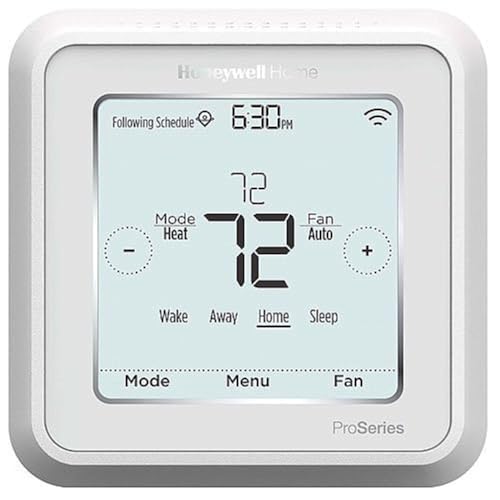
The Lyric T6 Pro offers Wi‑Fi connectivity with geofencing and multiple programming options (7‑day, 5‑2, 5‑1‑1, or non‑programmable). It is hardwired with a C‑wire requirement and is suitable for two‑stage heat/one‑cool heat pump or two‑stage/ two‑cool conventional systems. Best for: households seeking advanced scheduling, location‑based automation, and robust compatibility. Caution: It requires proper C‑wire installation and wiring compatibility.
Suuwer Non‑Programmable Heat Pump Thermostat

The Suuwer model targets straightforward heat pump control with up to two heat and one cool stage. It emphasizes a blue backlight display and broad compatibility with 24V conventional single‑stage systems in addition to heat pumps. Best for: buyers who want a simple upgrade without programming features. Limitation: It may not support more complex HVAC configurations beyond 2H/1C.
Non Programmable Digital Thermostat: Miuputake

The Miuputake thermostat supports multiple system types including heat pump setups and conventional single‑stage systems. It is a non‑programmable model designed for easy DIY installation with a backlit display and simplified controls. Best for: users who want a cost‑effective, no‑frills thermostat. Caution: Verify compatibility with your specific heating and cooling configuration before purchase.
Buying Guide
- System compatibility: Ensure the thermostat supports your heat pump configuration (2H/1C, 2H/2C, or heat pump with auxiliary heat). Some models support only single‑stage or non‑programmable setups.
- Power and wiring: Check whether your system requires a C‑wire. Several models operate with 24VAC power or batteries, while others demand a proper C‑wire connection.
- Smart features: If you want remote control and smart home integration, prioritize models with Wi‑Fi, app control, and voice assistant compatibility. Matter certification can improve interoperability across ecosystems.
- Programming vs. non‑programmable: Programmable thermostats offer tailored schedules, which can save energy. Non‑programmable units are simpler to operate and install.
- Display and usability: Large, backlit displays help readability for all ages. Consider units with clear menus and straightforward controls for quick adjustments.
- Installation complexity: Some units require wall footprint checks and precise wiring. DIY installations benefit from universal sub‑bases and clear wiring diagrams.
- Limitations to watch: Avoid models that explicitly do not support line voltage or 110–240V baseboard systems if you use those configurations.
Frequently Asked Questions
- What is a C-wire and why do I need it?
A C‑wire provides a continuous power source to your thermostat. Some Wi‑Fi and smart thermostats require it for reliable operation; others can operate on batteries or 24VAC power, reducing the need for a C‑wire.
- Can I install a thermostat myself if I have a heat pump?
Yes, many non‑programmable or simple programmable models are designed for DIY installation. Always confirm compatibility with your system and follow the manufacturer’s wiring diagram.
- Is geofencing useful for heat pump thermostats?
Geofencing uses your phone’s location to adjust climate settings when you leave or approach home, which can save energy for homes with heat pumps. It requires a compatible thermostat and app.
- Will wireless thermostats work with older HVAC setups?
Most wireless models support common 24V heat pump and conventional single‑stage systems. Some models do not support line‑voltage or high‑voltage baseboard heating; check specifications.
- What should I consider before buying a programmable thermostat?
Consider scheduling flexibility, energy‑saving features, compatibility with your heat pump, and whether you prefer app control or offline operation.
- Do all these thermostats require a hub or app?
Most listed options use Wi‑Fi and include a smartphone app. Some may require an account setup but do not need an external hub.