The best stop leak for an AC system depends on the system’s size, the leak, and whether you want extra leak-detection or moisture-control features. Leak Saver Direct Inject is a versatile option for many systems up to 5 tons, while ERRECOM Extreme Ultra is a polymer-free choice for small leaks. Leak Saver Ultimate 3-in-1 adds UV dye and moisture remover, and the small-system version is intended for systems up to 1 ton.
| Product | Best For | Key Difference |
|---|---|---|
| Leak Saver Direct Inject | General HVAC and refrigeration use | Direct injection; systems up to 5 tons |
| ERRECOM Extreme Ultra Easy Inject | Polymer-free formula preference | Reusable, refillable injector system |
| Leak Saver Ultimate 3-in-1 | Sealant plus added treatment features | Includes UV dye and moisture remover |
| Leak Saver Small System | Smaller-capacity systems | Designed for systems up to 1 ton |
| Leak Saver Direct Inject UV | Small leaks and leak locating | Includes UV dye |
Leak Saver Direct Inject

Best for buyers seeking a broadly compatible direct-injection sealant for an HVAC or refrigeration system up to 5 tons. The manufacturer lists compatibility with many refrigerants and oils, including R-410A, R-22 replacements, and common automotive refrigerants; ammonia is excluded.
The product is designed to seal small leaks when the system has not lost its complete refrigerant charge within seven days. It reacts with air and moisture at the leak site. Injection uses a basic manifold gauge set or a compatible Leak Shot kit, rather than a syringe or pressurized can.
Limitation: It is not presented as a fix for a system that has lost its full charge, and adapters may be needed for automotive or mini-split applications.
ERRECOM Extreme Ultra Easy Inject

Best for buyers who prioritize a polymer-free formula and a reusable, refillable injection system. ERRECOM says the formula does not react with moisture or oxygen and is designed to avoid blockages or damage to components such as expansion valves, capillary tubes, and Schrader valves.
This product is intended for small refrigerant leaks in HVAC and refrigeration systems up to 6 tons. Its instructions call for a five-minute vacuum test to check whether the leak is suitable for repair with the product. The included Easy Inject system is described as reusable with later cartridge refills.
Limitation: A vacuum test is part of the stated suitability check, and the product is aimed at small leaks rather than every refrigerant-loss problem.
Leak Saver Ultimate 3-in-1
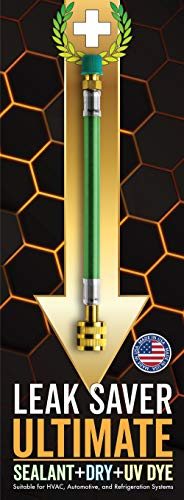
Best for buyers who want sealant with additional moisture-removal and leak-detection features in one package. The product combines refrigerant leak sealant, moisture remover, and UV dye. The dye can help identify larger leaks that may not be suitable for sealing.
It is listed for most HVAC systems up to 5 tons, as well as automotive, refrigeration, and other systems. The manufacturer states that it works with many refrigerants and oils, with ammonia excluded. Like the standard Leak Saver, it is intended for leaks where the complete refrigerant charge has not been lost within seven days.
Limitation: The added dye and moisture remover may be unnecessary if the buyer only needs a basic sealant or already has a separate leak-detection plan.
Leak Saver Small System

Best for buyers with a system rated up to 1 ton who want a version sized for smaller equipment. It uses the Leak Saver direct-injection approach and is listed for a range of system types and refrigerants, excluding ammonia.
The manufacturer describes it as a treatment for small leaks that have not caused the complete refrigerant charge to be lost within seven days. Installation uses a manifold gauge set or a compatible injection kit. This smaller-system designation makes it a more relevant selection than a larger-capacity option when the equipment falls within its stated limit.
Limitation: Do not select it for a system above its stated 1-ton capacity; confirm equipment capacity and product instructions before use.
Leak Saver Direct Inject UV

Best for buyers who want a sealant that also adds UV dye for locating a leak. The manufacturer says the dye can illuminate the leak site when used with a UV flashlight, particularly when a leak is too large for sealant to close. That makes it useful when the cause or location of refrigerant loss is not yet clear.
The product is listed for AC, refrigeration, and automotive systems up to 5 tons and is injected with a manifold gauge set or compatible injection kit. It is intended to seal small leaks; its UV dye provides a separate diagnostic aid.
Limitation: A UV flashlight is needed to view the dye, and the product does not claim that every leak can be sealed.
Buying Guide: How To Choose AC Stop Leak
What size system do you have?
Check the equipment capacity before choosing a product. The options here cover stated limits of up to 1 ton, 5 tons, or 6 tons. A product’s capacity label is not a substitute for checking its full instructions and confirming suitability for the specific equipment.
Is the leak small enough for sealant?
These products are described as solutions for small refrigerant leaks, not as universal repairs. Leak Saver states that its sealant is intended for use when the complete charge has not been lost within seven days. ERRECOM recommends a five-minute vacuum test to check whether a leak is suitable for its product. A large or continuing leak may need diagnosis and repair instead.
Do you need UV dye or moisture removal?
Choose a UV-dye option if you need help locating a leak with a UV flashlight. The Ultimate 3-in-1 also includes moisture remover. If those features are not needed, a basic direct-injection product may be a simpler match.
Check refrigerant and injection requirements
Confirm that the product lists your refrigerant and system type. The Leak Saver products listed here exclude ammonia. Also check injection-port requirements and whether you have the necessary manifold gauge set or adapter. Some automotive and mini-split applications may require specific adapters.
When should you choose a polymer-free formula?
ERRECOM Extreme Ultra is described as polymer-free and non-reactive with moisture or oxygen. Buyers comparing sealant formulas can use this distinction when evaluating product instructions and component concerns. Follow the manufacturer’s procedures, including any required leak-suitability test.
Frequently Asked Questions
Does AC stop leak work on every refrigerant leak?
No. The products described here are intended for small leaks, and manufacturers state limits or suitability checks. A major leak may require professional diagnosis and repair.
Can AC stop leak be used if the system has lost all its refrigerant?
Leak Saver says its product is intended for leaks where the complete refrigerant charge has not been lost within seven days. Check the selected product’s instructions before application.
What is the difference between sealant and UV dye?
Sealant is intended to close a suitable small leak. UV dye helps reveal a leak location when viewed with a UV flashlight; it does not itself repair the leak.
Do these products work with automotive AC?
Some listed Leak Saver products state compatibility with automotive systems, but adapters may be required. Verify the exact product, refrigerant, and connection requirements before use.
Should a homeowner install AC stop leak?
Injection may require gauges, adapters, and refrigerant-system procedures. If you do not have the necessary equipment or training, ask a qualified HVAC or automotive AC professional to evaluate the leak and follow the product instructions.