Looking for reliable red and white ball valves to control water flow in home, garden, or pool systems? This guide highlights five solid options that are easy to install, durable against corrosion, and suitable for household projects. Each product is best for a specific use case, from irrigation to pipe connections, so you can pick the right valve based on pipe size, pressure rating, and installation style.
| Product | Size / Type | Best For | Key Note |
|---|---|---|---|
| Valterra 700-12F | 1/2″ FPT, Schedule 40 PVC | General plumbing and inline connections | Corrosion resistance; 150 ps operating pressure |
| uxcell 3/4″ Ball Valve | 3/4″ NPT ends, red/white | Easy flow control in compact setups | High strength, chemical resistance |
| Midline Valve 482T600 | 6″ length, PVC, red T-handle | Shut-off for larger runs; not for potable use | Leak-free seal with EPDM O-rings |
| YADIAN 1-1/2″ PVC Ball Valves | 1-1/2″, slip ends, red T-handle | Pool, irrigation, or larger water lines | 150 psi at 73°F |
| ERA 1/2″ Schedule 40 PVC Ball Valve | 1/2″, slip x slip | Irrigation and indoor/outdoor cold water | Fast quarter-turn shut-off |
Valterra 700-12F PVC Ball Valve, White, 1/2″ FPT

Product overview: Schedule 40 PVC construction provides strength and corrosion resistance. It is rated for up to 150 psi and is designed to connect two pipes in the same direction with an inline valve configuration. This makes it suitable for compact plumbing runs in utility rooms or irrigation lines.
Best for: Homeowners and DIYers needing a compact inline valve for non-potable water lines with modest pressure. It is ideal for simple piping projects where space is limited and a white PVC body helps visibility in tight installations.
Limitation: Not intended for high-pressure or potable-water applications. Ensure compatibility with solvent-weld or threading as needed in your system.
uxcell PVC Ball Valve Supply Pipe Knob Threaded Ends 3/4″

Product overview: This valve features threaded ends for straightforward installation and an easy-to-control water flow. Constructed from PVC with corrosion resistance, it’s a practical choice for basic supply lines and smaller irrigation circuits.
Best for: Small to medium homeowners’ projects where a compact, affordable valve with threaded ends is preferred. The 3/4″ size fits many garden and utility supply lines.
Limitation: Not optimized for potable water in some regions; verify local requirements and material compatibility for drinking-water lines.
Midline Valve 482T600 PVC Ball Valve

Product overview: This 6″ white PVC ball valve uses EPDM O-rings and TPE seats to deliver a leak-free seal, with a red T-handle for rapid flow control. It is compatible with both Sch. 40 and Sch. 80 pipes and has a rating of 150 WOG/PSI at 73°F.
Best for: Larger, stationary installations such as main shut-offs in utility rooms or outdoor lines where a robust seal and quick shut-off are valued. Not recommended for potable-water use due to design notes.
Limitation: Not intended for potable water in some contexts; confirm local code compliance and material suitability for drinking applications.
YADIAN 2 Pack 1-1/2” PVC Ball Valves
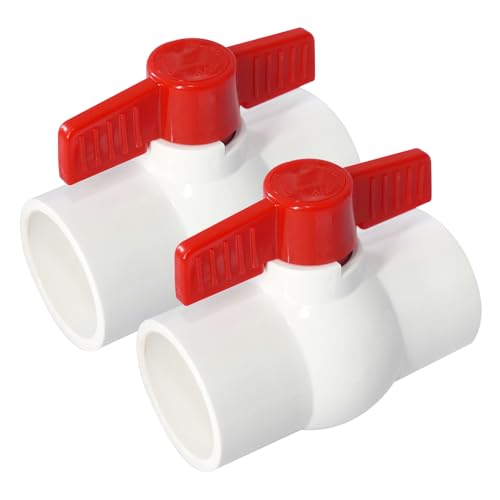
Product overview: This 2-pack includes 1-1/2″ PVC ball valves with slip sockets and a red T-handle for on/off control. Rated up to 150 psi at 73°F, these valves are suitable for irrigation, pool lines, and larger water projects.
Best for: Projects requiring larger pipe diameter with straightforward manual shut-off. The 2-pack helps in multi-branch setups or spare valves for future expansions.
Limitation: Not designed for potable-water use in all configurations; verify local plumbing codes and compatibility with your system materials.
ERA 1/2″ Schedule 40 PVC Ball Valve

Product overview: A 1/2-inch white Schedule 40 PVC ball valve with slip x slip connections. The valve features a smooth red T-handle for fast shut-off, designed for indoor and outdoor cold-water applications with minimal pressure loss.
Best for: Irrigation, lawn systems, and simple plumbing tasks where a compact, reliable shut-off is needed. The slim profile makes it easy to fit in tight spaces.
Limitation: For some potable-water installations, confirm compatibility and local code requirements before use.
Buying Guide
- Pipe size compatibility: Match valve size to your pipe diameter (e.g., 1/2″, 3/4″, 1-1/2″).
- Connection type: Choose slip, socket, or threaded ends based on your assembly method (glue, threading, or compression).
- Material and rating: PVC valves are common for cold water and irrigation; check psi rating and temperature range (e.g., 73°F reference, 150 psi).
- Color cues and handles: Red handles typically indicate a stainless or metal handle variant; white bodies aid visibility in dark spaces.
- Application suitability: Distinguish potable-water use from irrigation or pool lines; ensure materials meet local codes.
- Leak prevention: Look for valves with EPDM O-rings or similar seals to improve leak resistance.
- Maintenance and spare parts: Consider models with readily available replacement handles or O-rings.
FAQ
- What is the difference between slip and threaded valve ends?
Answer: Slip ends are glued to PVC pipes, offering a leak-resistant joint, while threaded ends require threading or adapters for connection. - Can these valves be used for potable water?
Answer: Some models are suitable for potable water, but not all; check local codes and product specifications for drinking-water compatibility. - What psi rating should I look for?
Answer: Most residential PVC valves in this category are rated around 150 psi at room temperature; use within rated limits. - Why choose a red-handle valve?
Answer: A red handle helps quickly identify the valve’s position and facilitates rapid shut-off in emergencies or maintenance. - Are two-pack valves a good value for pools or irrigation?
Answer: Yes, two-packs can simplify multi-branch projects and provide spare units for future work. - What installation precautions are important?
Answer: Ensure proper pipe preparation, correct solvent weld or threading, and correct orientation to avoid leaks and flow restrictions.