Looking for a quiet high-CFM fan that can cool a room without keeping you up at night? This guide highlights five top Amazon picks that balance powerful airflow with low noise. Each option suits different spaces—from small desks to large garages. Choose based on room size, installation style, and whether you need wall-mount, tower, or drum fans. The following selections emphasize quiet operation, strong air movement, and practical features like timers, oscillation, and remote control.
Summary table of selected products:
- Product: DREO Tower Fan for Bedroom (DC Motor, 8 speeds, 4 modes) — Best for bedrooms and quiet nights
- Product: iLiving 20 Inch Heavy Duty Floor/Wall Mount Fan — Best for large spaces needing focused air
- Product: DREO 90ft Airflow Oscillating Standing Fan — Best for whole-room circulation
- Product: BILT HARD 24″ Ultra Quiet Drum Fan — Best for industrial spaces with loud environments
- Product: XPOWER FC-300 Air Mover — Best for fast whole-room circulation with compact form
DREO Tower Fan for Bedroom: Quiet Power, Big Breeze

Best for: Nightly sleep and quiet work environments. This tower fan uses an upgraded DC motor with TurboWind technology to deliver air speeds up to 28 ft/s and coverage up to 34 ft. Despite high performance, it operates quietly at about 20 dB, aided by an algorithmic impeller design and the Coanda effect. With 8 speeds and 4 modes, you can tailor wind to bedtime comfort or daytime cooling. Remote control and touch screen offer convenient adjustments.
Why it’s chosen: The combination of high airflow and low noise makes it ideal for bedrooms, home offices, or study areas where quiet operation matters. The 90° oscillation helps direct airflow efficiently across a room. A potential limitation: the more aggressive wind settings may feel drafty in very small spaces.
DREO Fan for Bedroom, 12 Inches, Quiet Table Fan
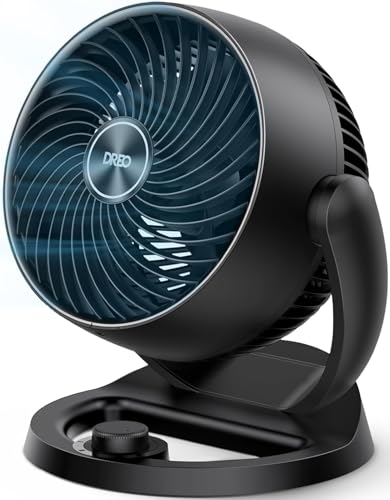
Best for: Desks, nightstands, and small workspaces needing focused cooling with minimal noise. This 12-inch table fan provides up to 70 ft of air projection and features a 60° adjustable tilt. It emphasizes quiet operation at 25 dB, making it suitable for bedrooms and quiet offices.
Why it’s chosen: For personal cooling in compact spaces, the table fan offers a quiet, efficient breeze without occupying floorspace. Limitation: lower overall airflow compared to larger floor or tower units.
iLIVING 20 Inch Heavy Duty Floor & Wall Fan

Best for: Large rooms, workshops, garages, and offices needing powerful airflow. The 5750 CFM rating is designed for serious cooling, with 360° tilt head and three speeds to target airflow precisely. It can be freestanding or wall-mounted, offering flexible placement.
Why it’s chosen: This unit provides robust air movement for big spaces and is versatile in mounting options. Caution: It is louder at higher speeds and intended for larger areas where loud air movement is acceptable.
BILT HARD 24″ Ultra Quiet Drum Fan

Best for: Industrial spaces, warehouses, and DIY workshops needing high-volume ventilation with a sturdy build. This drum-style fan uses a DC motor with variable speeds (7800 CFM down to 3300 CFM) and a design intended for lower noise relative to airflow.
Why it’s chosen: The drum design delivers sustained, high-velocity airflow across large areas. Limitation: This unit is larger and heavier than typical home fans, requiring space for placement and mobility.
XPOWER FC-300 Heavy Duty Air Mover

Best for: Home offices, small studios, or spaces needing efficient, compact air circulation with timer options. The FC-300 provides up to 2100 CFM with a focused airflow design and a 3-hour timer for automated operation.
Why it’s chosen: It offers strong airflow without occupying a large footprint and includes a timer for convenient, hands-free operation. Limitation: Not as disruptive in extremely large rooms as the bigger drum or industrial fans.
Buying Guide: Quiet High CFM Fans
- Room size and airflow needs: Larger rooms benefit from high-CFM units like iLiving or drum fans, while bedrooms or desks can use quieter tower or table fans.
- Sound profile: Look for dB specifications and motor type. DC motors generally run quieter than AC motors at comparable speeds, and blade design (Coanda or aero-efficient blades) reduces noise.
- Mounting and placement: Floor fans and towers save space; wall-mount options save floor area in tight rooms. Consider oscillation range and tilt to maximize coverage.
- Modes and controls: Multiple speeds and modes (Normal, Natural, Sleep, Auto) help tailor airflow and noise. Remote control adds convenience for bedrooms and offices.
- Power and energy efficiency: Higher CFM fans can consume more power. Choose models with energy-efficient motors and smart timers to balance performance with consumption.
- Durability and space: Industrial or heavy-duty models are robust but larger. For homes, prioritize compact forms with adequate airflow for everyday use.
- Maintenance: Check blade cleanliness and ease of disassembly. DC motors often have fewer maintenance needs than brushed motors.
Frequently Asked Questions
- What does CFM measure and why does it matter?
– CFM indicates how much air a fan can move per minute. Higher CFM means stronger cooling, but consider room size to avoid drafts. - Are quiet fans really louder at higher speeds?
– Yes. Most fans become louder as speed increases, but models with DC motors and optimized blade design maintain lower noise at higher output. - How do I choose between a tower and a drum fan for noise and airflow?
– Towers are better for bedrooms and living rooms with moderate airflow and space efficiency. Drum fans provide max airflow for large spaces but are noisier and bulkier. - Can fans help with energy savings?
– Yes. Fans don’t cool air like air conditioners but circulate air to improve perceived cooling, which can allow higher thermostat setbacks and reduce cooling costs. - Is oscillation important for even room cooling?
– Yes. Oscillation distributes airflow across the room, reducing hot spots and providing more uniform comfort. - What should I consider if I need a timer?
– Timers are useful for overnight use to turn the fan off automatically. Check if the model supports countdown timers and remote control.