The best pool heat exchanger depends on heat-source capacity, pool size, water chemistry, and plumbing connections. The QUELECO 102 kBtu titanium model is best for buyers seeking higher-capacity titanium construction; its 48 and 58 kBtu models suit smaller or moderate applications. For larger fresh-water pool systems, the AB 300 kBtu stainless steel exchanger is a high-capacity option, while the VEVOR 210K BTU model offers another stainless steel choice. Compare ratings carefully: stated capacity depends on operating conditions.
| Product | Stated capacity | Best suited for |
|---|---|---|
| QUELECO Titanium Twisted Tube | 102 kBtu / 30 kW | Higher-capacity titanium applications |
| QUELECO Titanium Tube and Shell | 48 kBtu / 14 kW | Smaller heating loads |
| QUELECO Titanium Tube PVC Shell | 58 kBtu / 17 kW | Moderate heating loads |
| AB 316L Same-Side Ports | 300 kBtu/hr | Large fresh-water pool systems |
| VEVOR 316L Stainless Steel | 210K BTU/h | Higher-capacity water-to-water heating |
QUELECO 102 kBtu Titanium Twisted-Tube Exchanger

Best for: Pool or spa systems that need a higher-capacity titanium exchanger for heat-pump or solar heating and cooling. Its listed capacity is 102 kBtu, or 30 kW, based on water entering at 26°C and leaving at 28°C.
The unit uses 99.99% pure titanium tubes and a PVC shell. The manufacturer lists customizable dimensions, water connectors, and heat-exchange capacity. Its stated water-side temperature range is 3°C to 35°C, with pressure limits of 87 PSI on the water side and 653 PSI on the refrigerant side.
Why it was selected: It has the highest listed capacity among the QUELECO titanium models here. Consideration: Confirm the temperature and pressure requirements of the planned system; its capacity rating is tied to specified test conditions.
QUELECO 48 kBtu Titanium Tube-and-Shell Exchanger
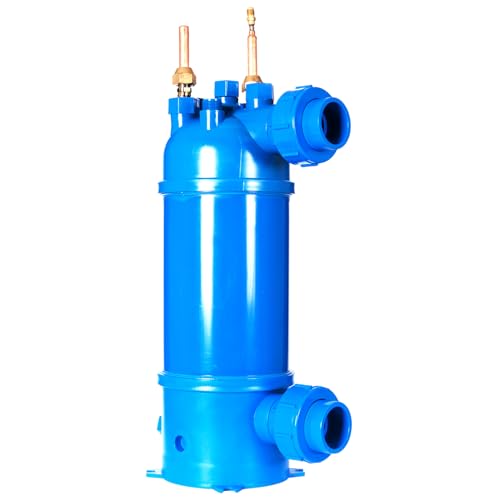
Best for: Buyers with a smaller heating load who want a titanium heat exchanger for a pool heat pump, solar system, or spa. The listed output is 48 kBtu, equivalent to 14 kW, under the stated 26°C-to-28°C water conditions.
QUELECO specifies 99.99% pure titanium tubes and customization options for dimensions, connectors, and capacity. The listed water-side temperature range is 3°C to 35°C, and the stated pressure limits are 87 PSI for water and 653 PSI for refrigerant.
Why it was selected: Its lower capacity provides a clear alternative to larger exchangers in this comparison. Consideration: It may not meet a system’s needs if the required heat output exceeds 48 kBtu; size it against the heat source and pool demand.
QUELECO 58 kBtu Titanium PVC-Shell Exchanger

Best for: Buyers whose estimated heating requirement falls between the QUELECO 48 and 102 kBtu models. This exchanger is rated at 58 kBtu, or 17 kW, based on water entering at 26°C and exiting at 28°C.
It has 99.99% pure titanium tubes in a PVC shell. Listed details include customizable dimensions and water connections, an operating water temperature range of 3°C to 35°C, and pressure limits of 87 PSI on the water side and 653 PSI on the refrigerant side.
Why it was selected: It offers an intermediate capacity while retaining the listed titanium tube construction. Consideration: The rating uses a two-degree Celsius water-temperature rise; actual performance depends on system conditions.
AB 300 kBtu 316L Same-Side-Port Exchanger

Best for: Larger fresh-water pool or spa systems using a suitable heating source. AB lists capacity up to 300 kBtu/hr for pools up to 23,800 gallons, based on a 60°F temperature difference between incoming heating water and heated water.
The exchanger is made from 316L stainless steel and has same-side ports with 2-inch and 1½-inch FPT connections. The listing describes it for chemically treated pool, spa, and hot-tub water and includes a one-year warranty.
Why it was selected: Its high stated capacity and specified port sizes make it a useful comparison for large systems. Consideration: The gallon guidance assumes fresh pool water and the stated 60°F temperature difference, so it should not be treated as a universal sizing limit.
VEVOR 210K BTU 316L Exchanger

Best for: Buyers comparing high-capacity stainless steel options for pools, spas, or hot tubs. VEVOR lists output up to 210K BTU/h and describes the unit as a water-to-water heat-transfer system.
Its construction includes 316 stainless steel tubing, 30 capillary tubes, and a stated heat-transfer area of 5 square feet. The listed operating temperature range is -18°F to 230°F. Why it was selected: The listed capacity and heat-transfer details give buyers useful specifications to compare with a heating source.
Consideration: The provided product details do not specify port dimensions or a pool-gallon capacity. Verify plumbing requirements and sizing with the seller or installer before choosing it.
Buying Guide: How to Choose a Pool Heat Exchanger
What capacity does your pool need?
Start with the heat source’s output, pool volume, desired water temperature, climate, and how quickly the pool should warm. Do not compare kBtu ratings as if all were measured under identical conditions. For example, QUELECO states its ratings at a 26°C-to-28°C water change, while AB gives its pool capacity guidance using a 60°F temperature difference between heating and heated water.
Should you choose titanium or stainless steel?
The listed QUELECO models use titanium tubes and are aimed at heat-pump, solar, and spa applications. The AB and VEVOR options use 316L or 316 stainless steel. Material suitability depends on water chemistry, the heating circuit, and manufacturer guidance. Confirm that the exchanger is appropriate for the pool’s treatment chemicals rather than assuming one material suits every installation.
Which plumbing and operating details matter?
Check port size and orientation, flow requirements, pressure limits, temperature range, and available installation space. The AB 300 kBtu model lists same-side 2-inch and 1½-inch FPT ports. QUELECO lists water and refrigerant pressure limits. The VEVOR information provided does not state port dimensions, so those should be confirmed before purchase.
How should you compare rated capacity?
Match the exchanger to the heat source and its operating temperatures. An exchanger’s advertised capacity can change with water flow and the temperature difference between circuits. Ask an installer to verify performance under the conditions your system will actually use.
Frequently Asked Questions
What does a pool heat exchanger do?
It transfers heat from a heating circuit, such as a boiler, solar loop, or heat pump, to pool or spa water without requiring the two water circuits to mix.
Can a heat exchanger be too large for a pool?
Capacity should suit the heat source and installation. A larger listed rating does not guarantee better performance if flow, temperature, or plumbing conditions are unsuitable.
Is titanium always better than stainless steel?
Not in every installation. Compare the exchanger material with the pool’s water chemistry, heating source, and manufacturer instructions before selecting a unit.
Do pool heat exchanger capacity ratings use the same conditions?
No. The products listed here state different rating conditions. Compare each rating alongside its temperature assumptions and verify expected output for your system.