Answer: If you’re improving airflow in grow tents, basements, bathrooms, or small workshops, inline ventilation fans deliver reliable, quiet performance. This guide highlights five top options and who they’re best for, with practical comparisons to help you choose. The top products favor different room sizes, noise tolerances, and energy use. Use this to select an inline fan that suits your space, whether you prioritize low noise, higher CFM, or energy efficiency.
| Product | Best For | Approx. CFM | Notes |
|---|---|---|---|
| VIVOSUN 4″ Inline Exhaust Fan | Small grow tents, bathrooms, kitchens | 130 | Low noise, EC motor |
| VIVOSUN 6″ Inline Exhaust Fan | Medium rooms, basements, greenhouses | 345 | Higher airflow, quiet operation |
| VIVOSUN D4 4″ Inline Duct Fan | Grow tents, hydroponics | 195 | Flow deflector reduces noise |
| Hon&Guan 6″ Inline Booster Fan | Quietly boost HVAC in larger spaces | 345 | Low power, compact |
| Voltset 4″ Duct Fan | Hobby projects, 3D printing, small rooms | 280 | Low noise, copper motor |
Buyer’s note: The best pick depends on room size, noise tolerance, and the need for energy efficiency. This guide includes practical considerations to help you compare airflow capacity, motor type, and noise levels without guessing from reviews alone.
VIVOSUN 4″ Inline Exhaust Fan & Speed Controller

Best for compact spaces where low noise matters. This 130 CFM unit is equipped with an upgraded EC motor for energy efficiency and long service life. It runs quietly at about 26 dB(A), making it suitable for apartments, small studios, and hobby rooms where quiet operation is essential.
- Best for: small grow tents, bathrooms, and kitchens that require steady ventilation without disruption.
- Why selected: low noise and energy-efficient EC motor maximize comfort in tight spaces.
- Limitation: lower airflow compared to larger 6″ models; may need staging for bigger areas.
VIVOSUN 6″ Inline Exhaust Fan & Speed Controller

Best for larger grow tents, greenhouses, and basements needing robust airflow. This 345 CFM fan balances high ventilation with a quiet profile of about 32 dB(A). The upgraded EC motor supports energy efficiency and longer service life.
- Best for: medium to large spaces that demand stronger exhaust without excessive noise.
- Why selected: high airflow without a dramatic noise increase; good energy performance.
- Limitation: higher initial cost than smaller 4″ units.
VIVOSUN D4 4 Inch 195 CFM Inline Duct Fan
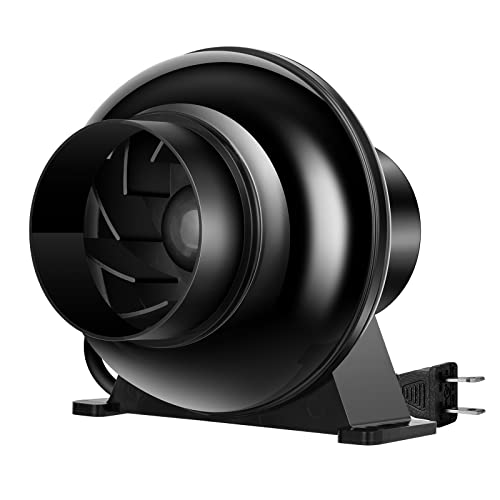
Best for precise airflow in grow tents and hydroponic zones. The D4 model delivers 195 CFM with a flow deflector to reduce turbulence and noise around 30 dB. ETL-listed motor with automatic reset enhances safety in busy equipment rooms.
- Best for: controlled environments where consistent humidity and temperature management matter.
- Why selected: strong airflow with noise reduction features; safe operation via automatic reset.
- Limitation: 4″ size may require ducting adjustments in larger installations.
Hon&Guan 6 Inch Inline Booster Fan

Best for noisy or hard-to-vent spaces where a 6″ boost is needed with minimal power draw. This 345 CFM unit uses a 19.2W DC motor to move air efficiently, designed for quiet operation in grow rooms, kitchens, workshops, and attics.
- Best for: quiet, energy-conscious boosting in HVAC systems.
- Why selected: low energy usage with strong airflow; compact form factor.
- Limitation: some users may prefer an integrated controller for variable speed needs.
Voltset 4 Inch Duct Fan

Best for versatile inline exhaust in small rooms, bathrooms, and grow tents. The Voltset 4″ offers 280 CFM with a 2200 RPM motor, delivering strong air movement while maintaining quiet operation. Copper motor technology supports durability and heat dissipation.
- Best for: projects requiring a balance of airflow, noise control, and durability.
- Why selected: higher airflow in a compact 4″ footprint with durable motor.
- Limitation: may not suit very large spaces without parallel setups.
VIVOSUN 6 Inch Inline Duct Fan 240 CFM

Best for compact rooms that still need reliable venting in basements and kitchens. This 6″ unit yields 240 CFM with a low-maintenance design and noise under 37 dB. It’s a solid choice when space is limited but airflow remains a priority.
- Best for: space-constrained installations needing steady airflow.
- Why selected: durable construction with quiet operation and solid CFM for its size.
- Limitation: 240 CFM is lower than some 6″ models, so assess your space needs.
VEVOR Inline Duct Fan 6-Inch 400 CFM

Best for large rooms and hydroponic setups that demand strong airflow. The 400 CFM rating supports extensive ventilation, with a quiet 34 dB operation and 30% energy savings from an efficient motor. Suitable for grow tents, electronic rooms, and basements.
- Best for: large areas or high-heat zones needing robust exhaust.
- Why selected: high airflow with energy-efficient operation.
- Limitation: may be overkill for very small rooms; expect higher upfront cost.
AC Infinity CLOUDLINE PRO S6

Best for controlled, quiet, programmable ventilation in grow tents and AV rack cooling. This 6” EC motor fan features a wired 10-speed speed controller and compatibility with UIS controllers for intelligent programming. It combines quiet operation with energy efficiency for critical environments.
- Best for: users who want precise, programmable ventilation control.
- Why selected: advanced controller options and PWM EC motor for efficiency.
- Limitation: higher complexity may require setup time and basic electronics familiarity.
Buying Guide: Inline Ventilation Fans
How to choose: Determine room size in square feet and desired air changes per hour. For smaller spaces, 100–150 CFM may suffice; for larger rooms or hot spaces, aim 300–400 CFM or more. Consider motor type: EC motors are energy-efficient and long-lasting, while AC motors can be cheaper upfront. Noise tolerance matters in living spaces; look for dB ratings and flow deflectors to minimize turbulence. Easy installation, durable housing, and safety features like thermal cutoffs add value in busy environments.
What to compare: Look at airflow (CFM), static pressure compatibility with ducts, motor efficiency, and noise. If you plan to add a speed controller, ensure the fan supports variable control. For hydroponics or grow tents, stable airflow helps maintain temperature and humidity; for basements and workshops, durability and maintenance are critical. Safety features and ETL or equivalent listings indicate compliance and reliability.
FAQ
- What CFM do I need for a small grow tent? Aim for a total airflow of about 1–2 air changes per minute in the tent, typically 100–250 CFM depending on tent size and heat load.
- Is a quieter fan always better? Not necessarily. If your space is large or the fan must move air through long ducts, you may trade some noise for higher airflow.
- Should I choose an EC motor or an AC motor? EC motors are more energy-efficient and have longer service life, making them better for ongoing use; AC motors are often cheaper upfront.
- Do I need a speed controller? If you require precise humidity and temperature control, a speed controller helps adjust airflow gradually to match conditions.
- Can I install a 6-inch fan in a 4-inch duct? You can with adapters or a reducer, but check airflow and pressure changes to avoid bottlenecks.
- Are inline fans safe for home use? Yes, when installed according to manufacturer guidelines and with proper electrical safety precautions.