If you’re cleaning up after a renovation, dealing with wildfire smoke, or needing better air quality in a workshop, a HEPA negative air machine can make a noticeable difference. This guide highlights five reliable models, explaining who each is best for and why they were selected. The top picks cover home repair, commercial restoration, and heavy-duty job sites, helping you choose the right balance of filtration, airflow, and portability.
Summary table of selected products shows each model’s focus and ideal user.
VEVOR Air Scrubber 550 CFM — All‑Purpose Home and Small Biz

Best for versatile everyday use. The VEVOR model combines a three-stage filtration stack (pre-filter MERV-10, carbon filter, and an H13 HEPA filter) with a 550 CFM maximum airflow. It’s well suited for apartment renovations, small offices, and mid‑sized rooms where fast air cleaning is beneficial. The integrated control panel makes it easy to adjust airflow, set a timer, and monitor filter changes. A potential limitation is size for very small spaces, where compact units may be easier to deploy.
Who it’s best for: homeowners or small business owners needing robust filtration without specialized installation.
Why selected: strong 3‑stage filtration with true HEPA capture at a high airflow rate supports rapid air quality improvements.
Consider this if you want a stackable, user-friendly unit with clear filter indicators and decent room coverage. Avoid this if you require the smallest possible footprint or ultra-quiet operation in a bedroom or study.
ALORAIR Air Scrubber — Heavy‑Duty 3‑Stage Filtration
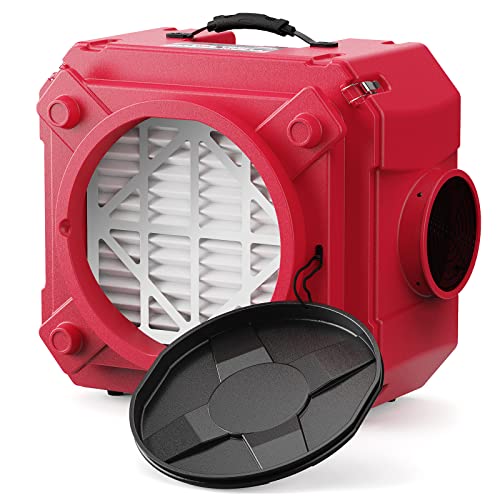
Best for construction and restoration sites. This unit uses a multilevel filtration approach with a MERV-10 pre-filter, an activated carbon stage, and a HEPA filter that captures 99.97% of particles ≥0.3 microns. Its rotomolded shell supports rough handling on job sites and the unit can be stacked for higher combined airflow. An indicator light helps track when to replace filters. A limitation is that stacking three units can increase noise and space needs.
Who it’s best for: professional restorers, contractors, and large home projects where strong filtration and durability matter.
Why selected: excellent durability, clear filter lifecycle cues, and the option to chain up to three units for higher airflow when needed.
Consider this if you require rugged build and easy scalability. Avoid this if you need ultra-quiet operation in a small workspace.
CADPXS Shield‑550 — Commercial 550 CFM Filtration

Best for professional restoration and large home projects. CADPXS Shield‑550 emphasizes a whole‑home like purification on job sites with a 550 CFM capacity and a 3‑stage filter stack (MERV‑10 pre-filter, carbon, HEPA). The unit targets odors and VOC reduction alongside particle removal, making it suitable for water or fire damage restoration. Its heavy‑duty design is built for commercial environments. A potential limitation is the possible need for longer setup time in very tight spaces.
Who it’s best for: restoration crews, contractors, and builders needing odor control alongside particle removal.
Why selected: strong odor and VOC reduction combined with solid filtration and commercial design features.
Consider this if you prioritize odor control and heavy‑duty performance. Avoid this if you need the smallest, lightest unit for quick, one‑room cleanup.
MOUNTO HEPA500 — Portable 500 CFM Air Purifier
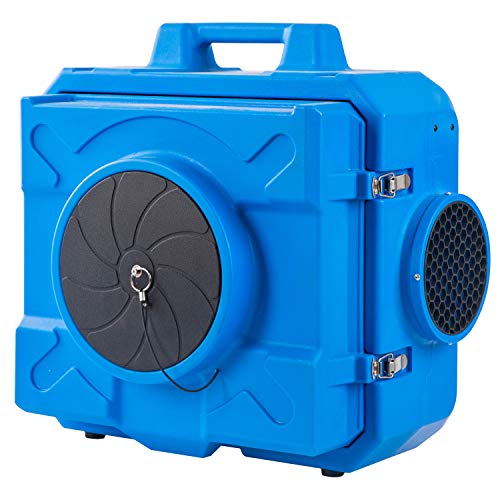
Best for portable, frequent movers. The MOUNTO HEPA500 combines portability with a 500 CFM airflow, rotomolded construction for durability, and a stackable, dual GFCI outlet setup for flexible use on job sites. It’s designed for home repairs and construction cleanup but remains manageable for quick shifts between rooms. A limitation is that the lower top-end CFM compared to 550‑CFM models may require more time for large spaces.
Who it’s best for: homeowners or small contractors needing a portable, durable option with straightforward operation.
Why selected: strong portability, durable materials, and practical power features for frequent repositioning.
Consider this if you need a lighter, easier-to-move unit. Avoid this if you’re cleaning a very large area in a single pass.
WEWEAL 550CFM Stackable Air Scrubber — Balanced Power

Best for industrial settings with stackability. WEWEAL’s three‑stage filtration includes MERV‑10, activated carbon, and true HEPA, delivering up to 550 CFM. The rotomolded plastic shell provides durability while remaining relatively portable. A notable advantage is the stackable design with a foldable handle for easier transport. A potential drawback is that higher airflow units may require more space when stacked.
Who it’s best for: mid‑to‑large rooms, workshops, and temporary industrial spaces requiring durable, scalable air purification.
Why selected: strong filtration trio with practical stackability and transport features.
Consider this if you want a flexible, modular setup. Avoid this if you need a compact, single‑room solution.
Buying Guide: Choosing The Right HEPA Negative Air Machine
- Airflow vs. room size — Measure the room and compare CFM to room volume (cubic feet). Higher CFM cleans larger spaces faster, but requires more energy and space.
- Filtration stages — Look for a three‑stage system (pre‑filter, carbon, HEPA) to handle dust, odors, and microscopic particles. True HEPA filters are typically rated to capture 0.3 microns at 99.97% efficiency.
- Portability and stacking — Rotomolded housings offer durability. If you anticipate moving the unit often, prioritize lighter weight and foldable handles. Stacking can boost overall airflow for large projects but increases footprint.
- Durability and safety features — GFCI outlets, circuit breakers, and filter change indicators help maintain safe, reliable operation in varied environments.
- Odor and VOC control — Activated carbon filtration specifically aids odor removal and VOC reduction, important in restoration and remodeling.
- Space and noise considerations — For bedrooms or quiet areas, prioritize models with lower noise profiles or placement strategies that minimize disruption.
Frequently Asked Questions
- What does a HEPA negative air machine do? It uses a multi‑stage filtration system to capture airborne particles and reduce odors, improving indoor air quality in rooms and on job sites.
- Do all HEPA air scrubbers remove smoke odors? Most 3‑stage units with activated carbon can reduce smoke odors, but effectiveness depends on filter quality and airflow for the space.
- Is higher CFM always better? Not always. Higher CFM cleans faster but may require more space and generate more noise. Choose based on room size and tolerance for noise.
- Can negative air machines be used in homes? Yes, for renovations, water damage restoration, and allergy management, provided there is proper placement and electrical access.
- How often should I replace HEPA and carbon filters? Filter lifespans depend on usage and contaminants. Look for indicators or scheduled maintenance reminders from the unit.
- Are these units stackable? Several models are designed to be stacked for higher combined airflow, useful for large spaces or construction sites.