For homeowners and small businesses seeking reliable condensate removal, these condensate pumps offer automatic drainage, safety features, and compact designs suitable for HVAC, refrigeration, and dehumidifying equipment. This guide highlights five top options, who they’re best for, and clear comparisons to help you choose.
Buying in a hurry? Here’s a quick summary of the featured pumps:
| Product | Best For | Key Benefit |
|---|---|---|
| Little Giant VCMA-15ULST | Small to mid-sized HVAC/DH systems | Compact footprint with 1/50 HP motor |
| Little Giant VCMA-20ULS | Medium condensate loads | Higher flow with 1/30 HP motor |
| Aquastrong 1/38 HP 85 GPH | Dual- or multi-unit setups | High lift and safety switch option |
| Cleartide HVAC Pump | Quiet operation and safety monitoring | Ultra-quiet, 144 GPH with safety switch |
| GuardFlow Mini Split Condensate Pump | Mini-split and tight spaces | Ultra-quiet, ≤20 dB(A) |
Little Giant VCMA-15ULST 115V, 65 GPH

The Little Giant VCMA-15ULST is a compact automatic condensate pump designed to remove condensate produced by boilers, furnaces, air conditioners, and de-humidifiers. It uses a vertical-type switch to minimize footprint and is thermally protected for reliability. The 1/50 HP motor delivers consistent drainage while a durable ABS tank and stainless steel motor shaft support longevity. Suitable for residential and light commercial HVAC tasks where space is at a premium and 140°F (60°C) water is expected.
Best for: small HVAC units or dehumidifiers with limited installation space, where a compact pump is preferred. Consider this when you need a low-profile solution and are okay with a modest 65 GPH output. Caution: no integrated overflow safety switch in this model, which means you should monitor high-water events to prevent overflow.
Little Giant VCMA-20ULS 115V, 80 GPH

The VCMA-20ULS offers a higher condensate capacity with a 1/30 HP motor and 80 GPH flow. It’s thermally protected and built to last with an ABS tank, stainless steel shaft, and a wall-friendly form factor. This unit is well-suited for mid-sized HVAC systems, dehumidifiers, or refrigeration setups that produce more condensate than smaller pumps can handle.
Best for: mid-sized condensate loads where more flow is beneficial and you want a robust, reliable pump with a longer duty cycle. Caution: choose this if you need a safety switch option; the model shown does not include one by default, so verify options if safety interlocks are a must.
Aquastrong 1/38 HP 85 GPH HVAC Condensate Pump
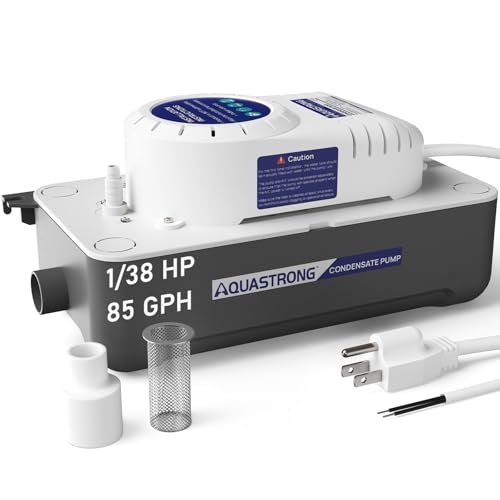
The Aquastrong model delivers up to 85 GPH with a vertical lift of up to 20 ft, suitable for AC units, furnaces, and dehumidifiers. It incorporates a high-performance thermally protected motor, a hall switch for auto operation, and a compact vertical design. The included safety features can be wired to HVAC equipment to shut off power if high water is detected.
Best for: multi-unit or high-lift configurations where a safety switch is desirable to prevent overflow. Caution: ensure proper vertical mounting and confirm compatibility with your existing wiring for the safety switch wiring option.
Cleartide Condensate HVAC Pump

The Cleartide pump operates at 100-240V, delivering up to 144 GPH with a lift height of 27.8 feet. It features a water-cooled brushless DC motor for quiet operation and higher efficiency, plus a three-indicator monitoring system and an overflow safety switch. The device is designed to minimize cycling and maintain performance with a 5/8 gallon tank capacity.
Best for: installations requiring very quiet operation and active monitoring to prevent overflow, including basements or living spaces near the equipment. Caution: heavier unit with more complex wiring; ensure electrical supply matches the 100-240V range for optimal operation.
GuardFlow Mini Split Condensate Pump

The GuardFlow mini split condensate pump is designed for ductless systems and other compact setups. It emphasizes ultra-quiet operation (less than 20 dB at 1 meter) and a compact wall-mounted form factor. The pump uses a float-switch to automatically drain condensate, ideal for quiet bedrooms, offices, or small apartments where gravity drainage isn’t available.
Best for: tight spaces and quiet environments where a discreet, wall-mounted unit is preferred. Caution: check the maximum head and ensure it suits your vertical lift requirements, as some mini-split configurations require specific lift heights.
Buying Guide: Key Purchase Considerations
- Lift height and flow rate: Match the pump’s lift (feet or meters) and GPH/LPH to your equipment’s condensate output and vertical distance to drain.
- Power and motor type: Look for thermally protected motors and energy-efficient operation. Brushless DC motors tend to run quieter and cooler.
- Safety features: An integrated overflow safety switch or safety wiring option helps prevent accidental spills in living spaces or basements.
- Mounting and footprint: If space is limited, favor compact footprints or wall-mounted designs. Consider whether a vertical or horizontal layout fits your setup.
- Compatibility and wiring: Verify voltage (115V vs 100-240V), required cords, and whether the unit supports direct wiring to HVAC equipment for safety interlocks.
- Noise level: For bedrooms, offices, or quiet areas, prioritize models advertised as ultra-quiet (low dB) to minimize disturbance.
- Tank capacity and maintenance: A larger reservoir reduces cycling, but may require more space. Consider ease of access for cleaning and service.
Frequently Asked Questions
- What is condensate pump capacity measured in GPH?
– GPH stands for gallons per hour and indicates how much condensate the pump can move in one hour. Pick a pump with a higher GPH than your unit’s daily condensate production if possible. - Do these pumps have built-in safety switches?
– Some models offer a built-in overflow safety switch or provide wiring options to connect to safety interlocks. Check the product page for specifics. - Can I install these pumps outdoors?
– Most condensate pumps are intended for indoor use where temperature and humidity are controlled. Verify enclosure ratings if outdoor installation is required. - What maintenance is required for condensate pumps?
– Regularly inspect for clogs, clean the reservoir, and ensure the float switch moves freely. Replace worn seals as needed to avoid leaks. - Is a higher lift height always better?
– Not necessarily. Choose lift height to match your drain location. Excessive lift can reduce efficiency or lead to overheating if the pump is too stressed. - How do I choose between a small and a high-capacity pump?
– For single-unit applications with modest condensate, a smaller pump is sufficient. For multi-unit installations or higher condensate loads, select higher GPH and lift capacity.