If you’re selecting a commercial sewage ejector pump, you need reliable performance, solid build quality, and clear guidance on who benefits most. This guide highlights 5 top options for professional or heavy-duty residential-commercial use, showing which job each is best suited for. The focus is on pumps that handle solids, offer automatic operation, and withstand continuous duty environments. The items below are organized to help building managers, plumbers, and facility technicians compare features quickly and choose the right model for their setup.
Summary table of chosen products. This quick reference helps buyers compare core attributes at a glance.
- Zoeller Waste-Mate 267-0001 – Heavy-duty automatic submersible, 1/2 HP
- Liberty Pumps P382LE51 – 1/2 HP simplex sewage system, 24 by 24-inch basin
- Siftary 1 HP Sewage Grinder Pump – High-flow grinder with cutting blade
- Little Giant 16S-CIM – 1 HP submersible with long leads, 230V
- Wayne WCS50T – 1/2 HP cast iron, automatic/manual, high capacity
Zoeller Waste-Mate 267-0001: Heavy-Duty 1/2 HP Submersible
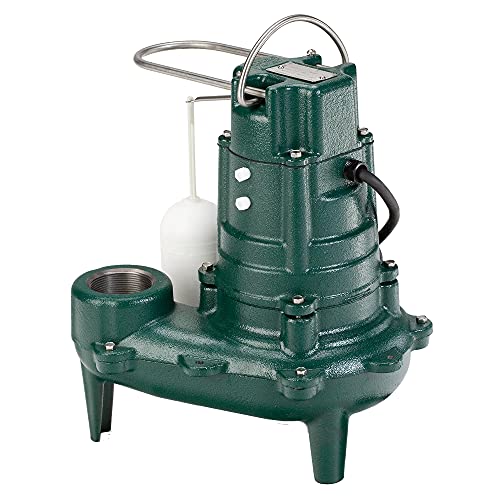
Best for: Commercial basements and small-to-medium facilities requiring a robust automatic sewage, effluent, or dewatering pump. This unit features a 2-pole mechanical switch and a non-clogging vortex impeller, enabling reliable operation with 2″ solids.
Why selected: The 1/2 HP motor and heavy-duty submersible design suit standalone or backup systems in commercial spaces. Its solid-wypass capacity allows efficient handling of typical wastewater with minimal maintenance in congested basements.
Limitations to consider: The pump uses a plastic impeller, which may not be ideal for extremely abrasive debris or heavy solids loads beyond typical residential/commercial use.
Liberty Pumps P382LE51 1/2-HP Pro380 Simplex System

Best for: Projects requiring a compact, easy-to-install sewage package with simple maintenance for residential or light commercial use.
Why selected: The Pro380 series is designed for straightforward installation, with a separate access cover and a shallow 24-inch basin that eases burial and access. This makes service calls faster and less disruptive in retrofit jobs.
Caution: The depth of burial may be constrained by existing trenching or foundation clearance; verify basin dimensions prior to installation.
Siftary 1 HP Sewage Grinder Pump

Best for: Basements or facilities with challenging solids loads, where pre-grinding reduces clog risk and improves discharge efficiency.
Why selected: The integrated cutting blade system and heavy-duty cast iron construction provide strong solids handling and durable submersible operation in harsh wastewater environments.
Limitations: This model emphasizes grinding capability; ensure electrical supply and noise considerations align with site regulations.
Little Giant 16S-CIM 1 HP Submersible Sewage Ejector

Best for: High-capacity transfer of sewage and effluent in basements or service areas requiring continuous-duty operation.
Why selected: With 9600 GPH at 0 ft lift and 230V operation, this model provides strong flow performance. Epoxy-coated cast iron housing and stainless steel shaft contribute to long-term reliability.
Caution: The unit is field-tested for continuous duty, but attention to electrical service upgrades and proper venting is essential for high-use environments.
Wayne WCS50T 1/2 HP Cast Iron Submersible

Best for: Facilities needing solid solids handling and flexible operation with auto or manual control options.
Why selected: It combines a 1/2 HP motor with a dual-control approach via piggyback float switch, supporting automatic cycling and manual testing. Its capacity suits demanding basements and wastewater applications.
Limitation: The performance depends on consistent electrical supply and proper float positioning; improper setup can lead to premature cycling or nuisance alarms.
Buying Guide: Key Considerations for Commercial Sewage Ejector Pumps
- Application environment: Determine whether the unit will operate in a residential basement or a light commercial area, and select a pump with appropriate materials and intake sizing.
- Wetted materials: Cast iron housings are common for durability; check for stainless steel shafts if corrosion resistance is important.
- Discharge and solids handling: Verify solids passage size (often 2 inches) and whether grinding is needed for fibrous or solid waste loads.
- Automatic vs manual operation: Float switches provide automatic control; consider a piggyback switch if you may need manual testing without disconnecting power.
- Install footprint and basin size: Some systems use compact basins; verify clearance and burial depth to fit the space.
- Electrical considerations: Ensure voltage, circuit capacity, and available outlets meet the pump’s requirements; in multi-unit facilities, plan for centralized wiring where possible.
- Maintenance and access: Choose models with accessible components and straightforward service procedures to minimize downtime.
- System integration: If you already operate a septic or sewage system, confirm compatibility with existing discharge lines and control panels.
Frequently Asked Questions
- What is a sewage ejector pump used for in commercial settings?
A sewage ejector pump moves wastewater from lower floors or basements to a sanitary sewer or septic line when gravity flow is not possible, handling solids and effluent as needed.
- What should I look for in a grinder pump versus a standard ejector pump?
Grinder pumps cut solids into small particles before pumping, reducing clog risk in lines with fibrous waste. Standard ejector pumps may suffice for clean effluent with minimal solids.
- Which material is best for longevity in a sewage pump?
Cast iron is common for durability; stainless steel shafts add corrosion resistance, beneficial in damp, chemical-laden environments.
- How important is the Solids-Size rating?
A higher solids-pass rating (for example, 2 inches) reduces clogging risk when solids are present in the waste stream.
- Do these pumps require professional installation?
Professional installation is often recommended for proper submersion depth, electrical wiring, and discharge routing to prevent backups and ensure code compliance.
- Can I run a sewage ejector pump in manual mode?
Yes, many models offer manual operation through a tether float switch or a separate control, which can be useful for testing or during outages.