For cathedral ceiling roof ventilation, the right solution depends on whether the roof has a vented attic or a shallow rafter space with dedicated air channels. A roof fan may help exhaust hot air from an attic, but it does not replace continuous intake and exhaust paths through a cathedral roof assembly. The Master Flow fan is best suited to larger attic spaces; the VEVOR and USDGTKN fans offer adjustable or high airflow for other applications. The turbine vents provide passive ventilation, while the REEPLAR unit is designed for existing 8-inch vertical ducting.
| Product | Best suited for | Ventilation type |
|---|---|---|
| Master Flow 1000 CFM Fan | Attics up to 1,600 square feet | Powered roof exhaust |
| VEVOR Adjustable Roof Fan | Spaces needing selectable airflow | Powered roof exhaust |
| USDGTKN 10-Inch Fan | Sheds, garages, and similar spaces | Powered exhaust |
| RDUIGT Turbine Vents | Passive roof ventilation | Wind-powered exhaust |
| REEPLAR 8-Inch Fan | Existing 8-inch vertical roof ducts | Ducted ceiling exhaust |
Master Flow 1000 CFM Power Roof Vent

Best for: A conventional attic connected to a larger roof area. The listed airflow is up to 1,000 CFM, and the product is specified for attic spaces up to 1,600 square feet. Its thermostat is included, according to the product name, and the listing describes it as a powered roof vent for removing hot and humid air.
This is the most directly attic-focused choice in the group. It is worth considering where an attic needs powered exhaust, provided the space has an appropriate intake-air path. A fan exhausting air without enough replacement air can undermine the intended ventilation strategy.
Limitation: The stated coverage applies to attic spaces, not necessarily to a cathedral ceiling’s rafter cavities. It should not be treated as a substitute for designed roof-deck ventilation channels.
VEVOR Adjustable-Speed Roof Exhaust Fan

Best for: A garage, kitchen, bathroom, or other space where airflow needs may vary. The listing describes a 220-watt motor, an aluminum-alloy housing, and two airflow settings of 900 and 1,500 CFM. Adjustable airflow can help users select between the listed ventilation levels rather than running at only one rate.
Choose this if selectable airflow is a priority and the installation location suits a roof exhaust fan. Its sturdy housing and stated corrosion resistance are additional product features. As with any powered exhaust, plan for how replacement air will enter the space.
Limitation: The listing does not specify a cathedral-ceiling rafter-channel application or attic-area coverage. Confirm the intended installation and airflow needs before choosing it for a home roof assembly.
USDGTKN 10-Inch Roof Exhaust Fan
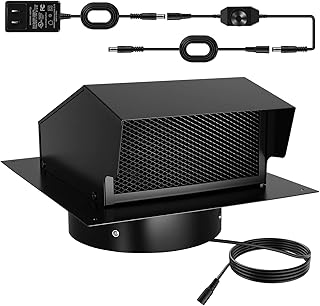
Best for: Buyers ventilating a shed, garage, greenhouse, shop, barn, or similar utility space. The product listing states 2,500 CFM, a speed controller, plug-and-play setup, and a 16.5-foot power cord. It also describes a galvanized-steel and aluminum exterior, an aluminum mesh guard, and operation as low as 45 decibels.
This model stands out for its stated high airflow and included speed control. It may suit a space where heat or moisture needs to be exhausted, but the listing’s broad area-coverage claim should not be used as a substitute for a ventilation calculation for a house.
Limitation: Its listed applications focus on utility buildings, not cathedral-ceiling roof assemblies. Verify that the mounting method, electrical setup, and weather exposure fit the planned installation.
RDUIGT Stainless Steel Turbine Roof Vents

Best for: Buyers considering passive, wind-driven roof exhaust. This set includes two non-powered turbine vents made from stainless steel, with galvanized bearings. The listing says wind rotates the turbines to exhaust indoor or attic air and describes the design as rain-resistant.
Because these vents do not use a powered fan, they are an option to compare when avoiding a motor-powered exhaust device is important. Their performance depends on wind conditions, so they are not equivalent to a fan with a stated CFM rating.
Limitation: Each vent has a 4.33-inch bottom opening, so confirm that the opening and roof installation suit the project. The product details do not establish suitability for ventilation channels within cathedral-ceiling rafters.
REEPLAR 8-Inch Ceiling Exhaust Fan

Best for: A room with an existing 8-inch vertical duct that vents through the roof. The fan is listed at up to 200 CFM and is intended for kitchens, laundry rooms, recreation rooms, and bathrooms. It requires a ceiling cutout of at least 8.25 inches and is not designed for wall venting.
This is a ducted ceiling exhaust option rather than a general attic fan. It may be a better fit when replacing or using compatible 8-inch vertical ductwork. The listing cautions that a tightly sealed room may develop negative pressure, so a door or window may need to remain slightly open during operation.
Limitation: It produces up to 8.5 sones, which the listing compares to a household vacuum cleaner. Avoid it if quiet operation is a priority.
Buying Guide: How To Choose Cathedral Ceiling Roof Ventilation
Does the ceiling have an attic or rafter cavities?
First identify the roof assembly. A conventional attic fan moves air through an attic space; it does not necessarily ventilate the narrow channels between a cathedral ceiling’s rafters. In a vented cathedral roof, the design generally needs a continuous route for air to enter near the eaves and travel through the roof cavities toward an exhaust opening near the ridge. Ask a qualified roofer or building professional to assess the assembly before adding a fan.
Should you choose a powered fan or a passive vent?
Powered fans provide a stated airflow rating or selectable settings, as shown by the Master Flow, VEVOR, and USDGTKN listings. Passive turbines use wind rather than a motor, so their airflow depends on conditions. Compare the installation requirements, power needs, airflow path, and the availability of intake air. Do not assume that a larger fan automatically improves a roof system.
What should you verify before installation?
- Check the required roof opening, duct diameter, mounting position, and electrical connection.
- Confirm that intake and exhaust openings work together and that the fan will not draw air from unintended locations.
- For a cathedral roof, verify that ventilation channels are open and continuous rather than blocked by insulation.
- Consider noise: the REEPLAR listing specifically describes high sound output, while other products provide different operating details.
- Check local building requirements and consult a professional when roof moisture, condensation, or ice-dam concerns are present.
Frequently Asked Questions
Can an attic fan ventilate a cathedral ceiling?
Not necessarily. An attic fan exhausts air from the space it serves. It does not automatically create airflow through enclosed rafter cavities, which may need their own designed intake and exhaust route.
Do cathedral ceilings always need roof ventilation?
Requirements depend on the roof assembly, climate, and applicable building rules. A professional can determine whether the design should be vented or use another approved approach.
Is a turbine vent as powerful as a powered fan?
No direct comparison can be made from these listings: the turbine listing provides no CFM rating, while the powered models state airflow figures. A turbine’s operation also depends on wind.
Can I install the REEPLAR fan through a wall?
No. Its listing specifies 8-inch vertical ducting and says it is not for wall venting.
What is the first step before buying a roof fan?
Determine whether you are ventilating an attic, a room through ductwork, or the rafter channels of a cathedral ceiling. Then match the product to that air path and confirm the installation requirements.