When you need rapid moisture and odor control, high-CFM bathroom fans are essential. This guide highlights top options that move a lot of air with quiet operation, helping bathrooms sized up to several hundred square feet. Best for builders, renovators, or homeowners seeking powerful ventilation without disruptive noise, these picks balance airflow, efficiency, and ease of installation.
| Product | CFM | Best For | Notes |
|---|---|---|---|
| Panasonic WhisperCeiling FV-40VQ4 | 390 | Large bathrooms, quick moisture clearance | Energy Star, quiet operation |
| VIVOHOME 240 CFM With Humidity Sensor | 240 | Smart humidity-based control | Remote control, energy-efficient |
| ALORAIR 300CFM Inline | 300 | Attic or large spaces | Very strong airflow, flexible mounting |
| COSTWAY 200 CFM | 200 | Mid-sized bathrooms | Quiet 2 sones, durable housing |
| OREiN 160 CFM With Humidity Sensor | 160 | Smaller bathrooms, humidity-responsive | 3CCT, night light option |
Buyer type at a glance: contractors and remodelers may prioritize higher CFM for larger spaces; everyday homeowners often favor built-in sensors and quieter operation; installers look for easy retrofit compatibility and standard duct sizes.
VIVOHOME 240 CFM Exhaust Fan With Humidity Sensor

This 240 CFM unit is designed to clear steam and odors in medium-to-large bathrooms. It uses a 0.1 Sone ultra-quiet DC brushless motor and includes a 6-speed remote control with auto-flow options. A humidity-sensing mode auto-adjusts airflow across three levels, helping maintain comfort while saving energy. Best for bathrooms around 120–280 sq ft and for buyers who want hands-free moisture control.
Best for: households needing automatic humidity-based ventilation with remote control; better for spaces where quiet operation matters. Caution: long-term battery-free remote may require occasional alignment for consistent range.
ALORAIR 6 Inch 300CFM Inline Exhaust Fan

With 300 CFM, this inline fan delivers strong airflow suitable for quick moisture removal in larger bathrooms, kitchens, or attic spaces. It emphasizes quiet operation for an attic-mounted setup, with flexible installation options for ceilings or hanging configurations. Best for: spaces requiring high airflow with low indoor noise, especially where duct routing is flexible. Limitation: inline design may require more complex installation than ceiling-mount models.
COSTWAY 200 CFM Ceiling Mount Fan

This 200 CFM ceiling-mount model uses a robust metal housing and a thick ABS grille. It operates quietly at about 2 sones, making it suitable for larger bathrooms where noise is a concern but high airflow remains a priority. Best for: mid-to-large bathrooms needing strong ventilation without attic access; avoid if you require ultra-low noise levels or a ductless setup.
Fitop 130 CFM 1.5 Sones Ceiling Fan
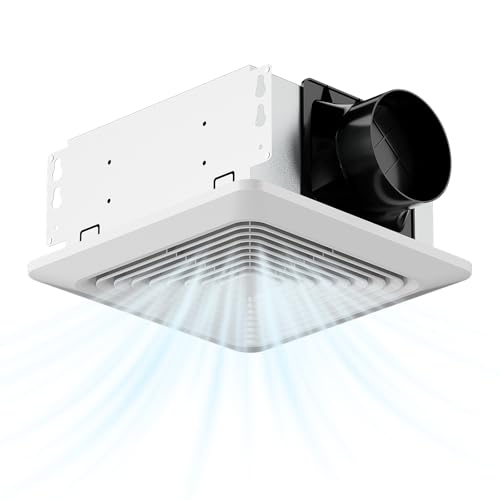
This compact unit delivers 130 CFM at a quiet 1.5 sones, ideal for smaller bathrooms or powder rooms. While not the highest CFM here, its compact size simplifies retrofits and installation in spaces with tighter ceiling cutouts. Best for: small bathrooms or remodels with limited ceiling space; caution: lower airflow for very large baths.
Panasonic WhisperCeiling 390 CFM

Panasonic’s WhisperCeiling delivers 390 CFM with a heavy-duty, permanently lubricated motor and durable housing. The high airflow makes it ideal for large bathrooms or spaces with persistent moisture. Best for: very large baths or suites requiring continuous, high-volume ventilation. Limitation: higher CFM may require more extensive ducting and mounting considerations.
Broan-NuTone 110 CFM Easy Install

While offering 110 CFM, this model emphasizes easy installation and retrofit from the room side, making it a practical option for upgrades where attic access is limited. Best for: smaller bathrooms or quick retrofits; caution: lower CFM compared to high-capacity units.
OREiN 3-in-1 160 CFM With Humidity Sensor

This unit combines ventilation with a humidity sensor, 1500-lumen light output, and a night light. It is designed for bathrooms up to 160 sq ft and supports 60% humidity activation. Best for: spaces needing integrated lighting and humidity control in a single unit; caution: not as high CFM as larger fans.
Buying Guide
What should you consider when choosing a high-CFM bathroom fan?
- Bathroom size and CFM needs: Use a rule of thumb of 1 CFM per square foot for unstandard layouts, and adjust for ceiling height and enclosure style. Larger baths benefit from 300+ CFM units.
- Somatic noise level: Look for units described in sones or decibels. Quiet operation is key in bedrooms or master baths; consider models around 1.0–2.0 sones for main bathrooms.
- Humidistat and smart features: Humidity sensors automatically adjust airflow, saving energy. Remote controls or smart integrations add convenience.
- Installation type: Ceiling-mount, inline, or retrofit-from-room-side installations each have pros. Inline fans offer strong airflow but may require duct routing planning.
- Duct size and compatibility: Standard duct is usually 4 inches or 6 inches. Check that the chosen model fits your existing ductwork and ceiling opening.
- Electrical and wiring: Some units come with plug-in options, while others require hard-wiring. Ensure compatibility with local codes and a safe installation plan.
FAQ
- What is a good CFM for a typical bathroom? A 50–150 CFM is common for smaller baths; 150–300 CFM suits medium to large baths; 300+ CFM is best for very large spaces or high-humidity areas.
- Do humidity sensors save energy? Yes. They adjust airflow based on moisture, reducing unnecessary ventilation when humidity is low.
- Is it better to mount fans in the ceiling or inline? Ceiling-mount is easier for retrofits; inline fans are powerful and flexible for long duct runs and attic installations.
- What should I consider for attic-access restrictions? Choose room-side installation or retrofit models that don’t require attic access when possible.
- Are higher CFMs always better? Not always. Higher CFMs remove moisture faster but can be noisier and require more powerful ducting.
- How do I know if a fan fits my ceiling opening? Measure your current ceiling cutout. Many models list compatible cutouts and mounting brackets in the specs.