A standing fan can help circulate air from an air conditioner and make a room feel more comfortable, but it does not replace an air conditioner or lower room temperature by itself. The DREO adjustable-height circulator is best for directing airflow across a room, while the DREO smart tower fan suits buyers who want app or voice control. The Levoit tower fan offers automatic temperature-based airflow, and the DREO misting fan adds evaporative cooling for buyers who can manage its water tank.
| Product | Best For | Standout Feature |
|---|---|---|
| DREO 90-foot Air Circulator | Roomwide circulation | Adjustable height and head angle |
| DREO Smart Tower Fan | Connected controls | Wi-Fi and voice control |
| Levoit Tower Fan | Automatic airflow adjustment | Built-in temperature sensor |
| DREO TurboPoly Fan 512 | Wide directional coverage | 120-degree oscillation and manual tilt |
| DREO TurboCool Misting Fan | Added evaporative cooling | Water tank and misting function |
DREO 90-Foot Air Circulator
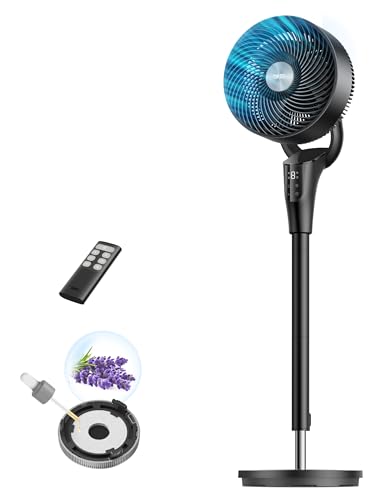
Best for: Buyers who want to move conditioned air beyond the area directly in front of a fan. The listed airflow reach is up to 90 feet, and the fan offers 90-degree horizontal oscillation plus a head that pivots vertically by up to 105 degrees.
The adjustable height ranges from 38 to 42 inches, so users can aim airflow at different levels. A DC motor, 8-plus speed settings, three modes, an eight-hour timer, and a stated low noise level of 20 dB add flexibility for bedrooms and living spaces.
Why it stands out: Its height adjustment and directional head make it a practical choice for helping distribute air from an air conditioner around a room. Limitation: The product information does not list a remote control, so check the control method if remote operation is important.
DREO Smart Tower Fan

Best for: Buyers who prefer connected controls alongside conventional remote and touch-panel operation. This tower fan lists Wi-Fi and voice control, 90-degree oscillation, eight speeds, and four modes: Normal, Natural, Sleep, and Auto.
DREO lists airflow up to 28 feet per second and a reach of up to 34 feet. The fan is also rated as low as 20 dB, with Sleep Mode and an eight-hour timer. Its oscillation and multiple settings can help circulate cooled air without requiring the fan to remain aimed in one direction.
Why it stands out: It combines smart controls with a useful range of airflow settings. Limitation: Buyers seeking adjustable standing height should note that the listed features do not specify a height-adjustment range.
Levoit Tower Fan With Temperature Sensor

Best for: Buyers who want airflow to adjust in response to room conditions. The built-in temperature sensor automatically adapts airflow to the environment, according to the product information.
This 36-inch tower fan offers 90-degree oscillation, five speeds, four modes, a remote, and a 12-hour timer. Listed airflow reaches up to 25 feet per second. The timer is longer than the eight-hour timers on some alternatives, which may suit buyers who want scheduled operation overnight.
Why it stands out: Automatic temperature-based adjustment distinguishes it from fans that rely only on manually selected speeds. Limitation: The listed information does not give a specific decibel figure, so buyers prioritizing a quantified noise level may prefer a model with one stated.
DREO TurboPoly Fan 512

Best for: Buyers who need broad, adjustable airflow coverage. This pedestal-style fan combines 120-degree horizontal oscillation with up to 120 degrees of manual vertical tilt. Its adjustable height ranges from 37 to 42 inches.
The product lists nine speeds, four modes, an eight-hour timer, a remote, and airflow reach up to 100 feet. It is designed to operate as a pedestal fan, oscillating fan, and air circulator. These features give users more ways to direct air from an air conditioner toward different parts of a room.
Why it stands out: Its wide horizontal sweep and manual vertical tilt offer more directional adjustment than the tower fans in this list. Limitation: Vertical tilt requires manual adjustment rather than remote control.
DREO TurboCool Misting Fan

Best for: Buyers who want more than air circulation from a standing fan. The TurboCool uses ultrasonic misting and a six-liter tank; its product information claims a temperature reduction of up to 10°F. It also lists 12 speeds, four modes, 90-degree oscillation, and airflow up to 34 feet per second.
Why it stands out: Unlike standard fans, it adds water-based evaporative cooling. The tank is described as detachable for rinsing, and the listed runtime ranges from up to seven hours of turbo mist to 30 hours on low per refill.
Limitation: Misting requires regular water refills and cleaning. Choose a standard fan instead if you do not want to maintain a tank or add moisture to the air.
Buying Guide: How To Choose A Standing Fan For Air Conditioning
Do you need circulation or added cooling?
For use with central or room air conditioning, prioritize oscillation, adjustable direction, and airflow reach. These features help move cooled air around the space. A conventional fan moves air but does not create refrigerated air or lower the room’s overall temperature. A misting fan adds evaporative cooling, but it also requires water and upkeep.
Should you choose a tower or pedestal design?
A tower fan has a slim footprint and typically distributes airflow through an oscillating column. A pedestal-style circulator often provides adjustable height and a tilting head, which can help aim air toward a bed, seating area, or another part of the room. Compare the exact adjustment range and oscillation angle rather than relying on design alone.
Which controls and settings matter?
Consider whether you want a remote, touch controls, Wi-Fi, or voice control. More speeds and modes allow finer adjustments, while timers can stop operation after a set period. For nighttime use, compare the stated noise level and check whether the fan has a sleep mode or a way to mute control sounds.
What should you check before buying?
- Match the fan’s listed airflow reach and oscillation to your room layout.
- Check the product’s height and whether vertical aiming is remote-controlled or manual.
- Choose a timer length that fits your typical use.
- For misting models, consider tank capacity, refill frequency, and cleaning needs.
Frequently Asked Questions
Can a standing fan make an air conditioner work better?
A standing fan can help circulate air conditioned by an AC unit, which may improve airflow distribution. It does not replace the AC or independently lower the room’s temperature.
Where should I place a fan when using air conditioning?
Position it to move air through the room rather than only blowing directly at one spot. Use oscillation or an adjustable head to direct airflow toward areas that feel less comfortable.
Is a tower fan or pedestal fan better for AC circulation?
A tower fan can suit buyers who want a slim, oscillating design. A pedestal fan may be better when adjustable height and a manually tilting head are priorities.
Does a misting fan replace an air conditioner?
No. A misting fan uses evaporative cooling and water; it is not a refrigeration-based air conditioner. Its usefulness depends on the product’s design and the conditions in the space.