Answering the common buyer question, these adjustable low pressure relief valves help protect compressors, irrigation lines, and fluid systems by releasing pressure at a set point. They’re ideal for installers and maintenance technicians who need precise control and robust construction. The following five products are selected for varied pressure ranges, materials, and compatibility, making it easier to match the right valve to your application and budget. The summary table below highlights each option so you can compare at a glance.
| Product | Best For | Key Range | Material Highlights |
|---|---|---|---|
| Sellerocity American Made Brass Pressure Relief 0-100 PSI | Home shops and small compressors | 0–100 psi | Forged brass body, stainless poppet, fluorocarbon O-ring |
| Midwest Control CPR-25 0-20 psi | Low-pressure systems needing fine control | 0–20 psi | Knurled screw with jam nut for field adjustment |
| 23120-3/4-PP Adjustable Valve (3/4″ NPT) | Sprayers and irrigation lines | 0–110 psi | 3/4″ NPT with 1/4″ gauge port, locking nut |
| Otoolling 1/2″ x 3/4″ Poppet Adjustable (100–300 psi) | Water, oil, or air in higher ranges | 100–300 psi | Solid brass, O-ring seal, calibrated knob |
| HEZONGSION 1/4″ NPT Mini Adjustable (0–30 psi) | Small lines with light pressure needs | 0–30 psi | SS304 stainless body, 15 psi set option |
Sellerocity American Made Brass Pressure Relief Valve 0-100 PSI

Best for: Small to mid-size compressors and pneumatic circuits needing reliable 0–100 psi protection. The micrometer-style adjustment lets users dial in an exact relief threshold, helping prevent overpressure with precision. The brass body and stainless poppet plus fluorocarbon O-ring seal boost corrosion resistance and long-term leak resistance. Universal 1/4″ NPT threading ensures broad compatibility with air tanks, pumps, and manifolds. Caution: verify system compatibility with brass in corrosive environments and ensure proper seating to avoid leaks.
Midwest Control CPR-25 0-20 psi

Best for: Systems that require intimate pressure control in the low-psi range. This valve is described as a proportional relief valve, not a fixed pop-type device, with a knurled adjustment screw locked by a jam nut for stable settings. It’s suitable for maintaining delicate pressures in finish air lines or small spray circuits. Limitation: field adjustment ensures it holds but may require periodic re-tightening in vibration-prone environments.
23120-3/4-PP Adjustable Valve (3/4″ NPT)

Best for: Sprayers, irrigation lines, and fluid systems needing a robust 3/4″ NPT connection with gauge port. Features include a 0–110 psi adjustable range with a locking nut for stable setpoints and a gauge port for straightforward monitoring. This valve helps minimize liquid waste by enabling return flow back to the source or pump inlet when pressure fluctuates. Caution: ensure gauge port fittings and threads suit your monitoring needs and avoid cross-threading with larger assemblies.
Otoolling 1/2″ x 3/4″ Poppet Adjustable (100–300 psi)
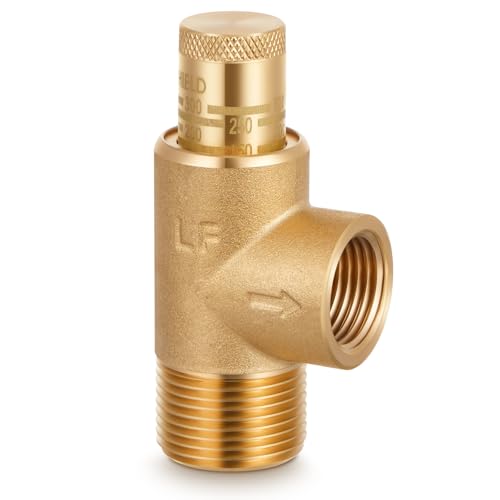
Best for: Higher-pressure needs within water, oil, or air systems where a 3/4″ outlet and 1/2″ inlet are required. The valve uses a brass body with a robust poppet and sealing design that minimizes leaks and maintains stable relief up to 300 psi. Choice is favorable for installations requiring a compact footprint while delivering reliable relief performance. Limitation: verify the exact inlet/outlet configuration matches your piping plan to avoid misfits in tighter spaces.
HEZONGSION 1/4″ NPT Mini Adjustable 0–30 psi

Best for: Small lines or compact systems where space is at a premium and low relief is required. The valve is built with SS304 stainless steel and a sealing material suitable for light-duty pressure relief at 0–30 psi. It’s a good choice for delicate water or irrigation segments with tight routing. Caution: at higher flow rates or harsher fluids, consider a valve with higher pressure capacity.
Buying Guide: Key Considerations For Choosing An Adjustable Low Pressure Relief Valve
- Pressure range and setpoint accuracy: Match the valve range to your system’s operating pressure. Consider valves with locking mechanisms to hold a precise setting in vibration-prone environments.
- Thread size and connection type: Verify NPT sizing (1/4″, 3/4″, 1/2″) and whether gauge ports or drains are needed for monitoring or venting.
- Material and corrosion resistance: Brass bodies are common for pneumatic and water systems; stainless steel components suit corrosive or demanding environments. Check O-rings and seals for compatibility with the working fluid.
- Valve type and response: Poppet vs. pop-type or proportional relief valves behave differently under fluctuating loads. Choose based on required response speed and leak characteristics.
- Size, weight, and installation space: Smaller valves save space but may have limited flow; ensure the chosen valve fits the piping layout and available mounting options.
- Maintenance and accessibility: Look for accessible adjustment screws, locking nuts, and clear gauge ports to simplify calibration and monitoring over time.
- Application compatibility: Confirm the valve’s suitability for water, oil, or air service, and ensure operating temperatures align with the fluid and environment.
Frequently Asked Questions
- What is an adjustable low pressure relief valve used for? It protects systems by venting excess pressure at a user-defined setpoint, preventing equipment damage and leaks.
- Which material is best for a water application? Brass bodies with compatible seals are common; stainless components offer extra corrosion resistance in harsh water or chemical environments.
- How do I set the relief pressure? Use the calibration knob or knurled screw, then lock the setting with a jam nut or cap if provided, and verify with a pressure gauge when available.
- Can I install these valves without adapters? Yes, many provide standard 1/4″ or 3/4″ NPT threads for broad compatibility, but always confirm thread type and orientation before installation.
- What maintenance is required? Periodic inspection for leaks, re-calibration after system changes, and replacement of seals or O-rings as needed.
- Are these safe for high-temperature or high-flow systems? Some models tolerate higher temperatures or flows; check the manufacturer’s data to ensure the chosen valve meets your operating conditions.