The best AC condenser cleaner liquid depends on whether you need a ready-to-use wash, a high-yield concentrate, or a foaming formula for stubborn grime. Quality Chemical Nu-Coil is a strong fit for a water-rinse cleaning routine, while Maplefield suits buyers seeking a concentrated no-rinse option. Leak Saver HD Power offers adjustable dilution, and Essential Values is a straightforward non-foaming liquid. The products below are selected for their stated condenser-coil uses and application details; always follow the product label and your equipment manufacturer’s instructions.
| Product | Best for | Application style |
|---|---|---|
| Quality Chemical Nu-Coil | Foaming coil cleaning | Apply, wait, rinse |
| Maplefield Concentrate | High-yield dilution | Dilute; no-rinse formula |
| Wholesalehome 4291-08 | Foam penetration | Alkaline foaming cleaner |
| Leak Saver HD Power | Adjustable dilution | Non-foaming concentrate |
| Essential Values Coil Cleaner | Simple liquid application | Spray, soak, rinse |
Quality Chemical Nu-Coil Concentrate

Quality Chemical Nu-Coil is best for buyers who want a foaming cleaner with a clearly described spray-and-rinse process. The product is a one-gallon concentrated alkaline coil cleaner intended for air conditioner condenser coils. Its stated cleaning targets include dirt, dust, grease, oil, and other debris.
The listed directions say to spray the foam onto the coil, wait 10 minutes, and rinse with water. The manufacturer describes the formula as non-corrosive and says it is suitable for aluminum, copper, and steel. Those details make it a relevant choice when material compatibility is a key selection question.
- Best for: Rinse-based cleaning of dirty condenser coils.
- Why it was selected: It specifies a wait time, rinse step, and supported metal types.
- Limitation: Rinsing is part of the stated process, so it is not the most convenient choice when water access is limited.
Maplefield Concentrated AC Coil Cleaner

Maplefield is best for buyers who prefer a concentrated liquid that can be diluted for repeated or larger cleaning tasks. The product information gives a 1:11 dilution ratio, with one gallon of concentrate making 12 gallons of cleaner. Its citrus formula is described as targeting stubborn dirt and grime on condenser coils.
This cleaner is described as no-rinse: mix it with water, spray it onto the coil, and allow the formula to work. That can reduce water use and simplify maintenance compared with products whose directions call for rinsing. Check the product label for the appropriate application and dilution instructions for your cleaning task.
- Best for: Buyers who value a high-yield concentrate and no-rinse application.
- Why it was selected: Its dilution ratio and intended condenser use are clearly stated.
- Limitation: It must be diluted before use, so it is less convenient than a ready-to-use product.
Wholesalehome Alkaline Foaming Cleaner

Wholesalehome 4291-08 is best for buyers looking for an alkaline foaming cleaner labeled for both evaporator and condenser coils. The product description says its foam penetrates coil fins and loosens grease, dirt, grime, and deposits. It is presented for residential and commercial cooling-system maintenance.
The listing also says the cleaner is designed to remove buildup that can impede airflow and heat transfer. A cloth is included, according to the product name. For buyers comparing application styles, this is a foam-based option rather than a specifically described no-rinse concentrate.
- Best for: Buyers who want foaming action for routine coil cleaning and service work.
- Why it was selected: The listed use includes condenser coils, and the formula is described as penetrating fins.
- Limitation: The provided product details do not specify a dilution ratio or exact rinse directions; confirm them on the label.
Leak Saver HD Power Coil Cleaner

Leak Saver HD Power is best for buyers who want a non-foaming concentrate with more than one dilution option. Its listed dilution range is 4:1 to 10:1, depending on the job. The product is described as a detergent, degreaser, and deodorizer for air-cooled condensers, evaporators, permanent filters, fan blades, and other equipment.
The manufacturer describes the alkaline formula as metal-safe and lists microchannel coils, ductless mini-splits, commercial and residential air conditioning units, and refrigeration equipment among its intended uses. For no-rinse application, the instructions call for a 10:1 dilution and enough moisture for condensate to form and rinse the coil.
- Best for: Buyers who need adjustable dilution for different cleaning jobs.
- Why it was selected: It explicitly lists condensers and provides a no-rinse dilution method.
- Limitation: No-rinse use depends on moisture and condensate forming; it is not simply a spray-and-walk-away choice in every condition.
Essential Values Non-Foaming Coil Cleaner
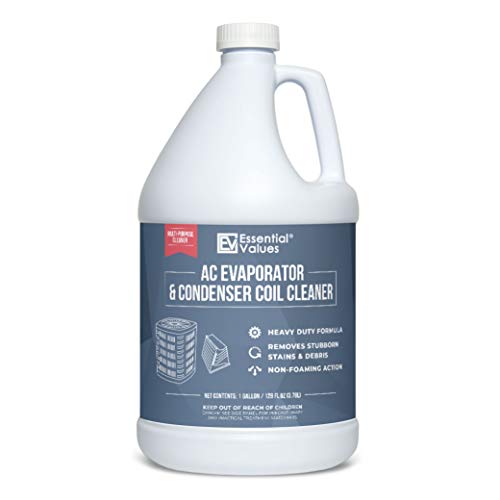
Essential Values is best for buyers seeking a non-foaming liquid that can be applied with a sprayer. The gallon product is described as a non-acidic cleaner for evaporator and condenser coils in residential and commercial air conditioning systems. Its listed instructions are to spray, soak, and rinse.
Dilution is not required, but the product information says dilution is recommended. The formula is presented as a fast-acting option for grease, grime, and stuck-on dirt. Since the listing does not provide a specific dilution ratio in the supplied details, buyers should consult the container directions before mixing.
- Best for: Buyers who want a non-foaming liquid with a simple spray-and-rinse process.
- Why it was selected: It is explicitly marketed for condenser coils and identifies its application steps.
- Limitation: The provided details do not state a recommended dilution ratio.
Buying Guide: How To Choose AC Condenser Cleaner Liquid
Should you choose a foaming or non-foaming cleaner?
Foaming products are designed to spread across coil surfaces and penetrate between fins. They may suit buyers targeting visible buildup, but foam does not remove the need to follow the label’s rinse instructions. Non-foaming liquids, such as Leak Saver HD Power and Essential Values, can be preferable when a buyer wants a liquid application or a concentrate with adjustable dilution.
Is a no-rinse formula right for your condenser?
A no-rinse label can make cleaning more convenient, but the application conditions matter. Maplefield is described as a no-rinse formula, while Leak Saver specifies a 10:1 dilution and moisture for condensate rinsing. If the instructions for a product call for rinsing, plan for safe access to water rather than assuming the cleaner will self-rinse.
What does dilution mean for coverage?
Concentrates require mixing before application. Compare the stated ratio and follow the product label; do not assume different formulas share the same mixing directions. Maplefield lists a 1:11 ratio, and Leak Saver HD Power lists a 4:1-to-10:1 range. Essential Values says dilution is optional but recommended, without a ratio in the supplied details.
How should you compare coil materials and cleaning needs?
Choose a cleaner whose label matches your equipment and coil type. Quality Chemical lists aluminum, copper, and steel as suitable metals, while Leak Saver describes use with microchannel coils and other air-cooled equipment. The product descriptions are not a substitute for checking the equipment maker’s guidance. Turn off equipment as appropriate and follow all label safety directions before cleaning.
Frequently Asked Questions
Can AC condenser cleaner liquid be used on evaporator coils?
Some products in this list state that they are for both condenser and evaporator coils, including Wholesalehome, Leak Saver HD Power, and Essential Values. Check the label before applying any cleaner to a specific coil.
Does condenser coil cleaner always need to be rinsed?
No. Rinse requirements vary by product. Quality Chemical and Essential Values describe rinse steps, while Maplefield is listed as no-rinse. Follow the instructions for the exact cleaner you use.
What is the difference between concentrate and ready-to-use cleaner?
A concentrate must be mixed with water at the specified ratio before use. Ready-to-use products require less preparation. Concentrate may provide more diluted solution, but the correct mixing ratio is essential.
Can I use household cleaner on an AC condenser coil?
These product details do not establish that general household cleaners are suitable for AC coils. Use a cleaner labeled for the intended coil and follow the equipment and cleaner instructions.
How do I select the right AC coil cleaner?
Compare the cleaner’s intended coil use, foaming behavior, dilution requirements, rinse directions, and stated material compatibility. Select the product whose directions match your equipment and cleaning setup.