Direct answer: for reliable halogen refrigerant detection, choose detectors that offer wide gas coverage, adjustable sensitivity, and practical probes for hard‑to‑reach areas. This guide highlights five top options, each best for different buyers—from DIY automotive enthusiasts to professional HVAC technicians. Use the table below to compare core capabilities and target user types at a glance.
| Product | Best For | ||
|---|---|---|---|
| Elitech WJL-6000S | Home and small shop users | 7 adjustable sensitivities and dual indicators | Versatile with broad halogen gas detection |
| Elitech CLD-100 | Techs needing fast response | Upgraded corona sensor and 6s preheat | Flexible probe included |
| Elitech ILD-200 | Professional diagnostics | Infrared sensor with strong anti-interference | High sensitivity, wide gas range |
| VIVOHOME | Automotive and home HVAC technicians | 7 sensitivity levels and dual-color LED | Flat beeps and strong UV/white light |
| Inficon 705-202-G1 | High-accuracy professional use | Heated diode sensor, A2L certified | Reliable all-halogen gas detection |
Elitech Freon Leak Detector WJL-6000S

The WJL-6000S is a halogen refrigerant detector designed for R22, R134A, R404A, R410A, and R1234YF, plus all halogenated refrigerants. It features seven adjustable sensitivity levels with a maximum sensitivity of up to 0.21 oz/yr, making it suitable for self‑checks in autos and home systems. Audible and visual indicators provide clear leak feedback, and dual battery indicators help monitor power. Best for DIYers and small shops that need a versatile, all‑gas detector in one compact unit.
Who it’s best for: homeowners performing seasonal AC checks or small‑shop technicians who demand broad gas coverage with adjustable sensitivity. Why selected: a balance of gas compatibility, user‑adjustable sensitivity, and clear indicators supports quick, actionable leak localization. Caution: performance can depend on proper probe placement in tight spaces; ensure the detector is calibrated and the batteries are fresh for best results.
Elitech CLD-100 Freon Leak Detector

The CLD-100 is an upgraded version of the standard halogen detector, featuring a traditional corona sensor with updated analogue circuitry for fast triggers on common refrigerants like R11, R22, R134A, R404A, and R410A, plus all halogenated gases. It offers six‑second preheating, six adjustable sensitivity levels up to 0.21 oz/yr, and a flexible probe around 8.26 inches for hard‑to‑reach areas. Best for field technicians who need rapid, reliable detection with a long probe for tricky spots.
Who it’s best for: service professionals performing frequent leak checks in engines or compact HVAC compartments. Why selected: rapid response, adjustable sensitivity, and an extended probe improve accessibility and speed in busy diagnostic workflows. Caution: traditional corona sensors may be more affected by strong ambient contaminants than infrared systems in some environments.
Elitech ILD-200 Infrared Refrigerant Detector
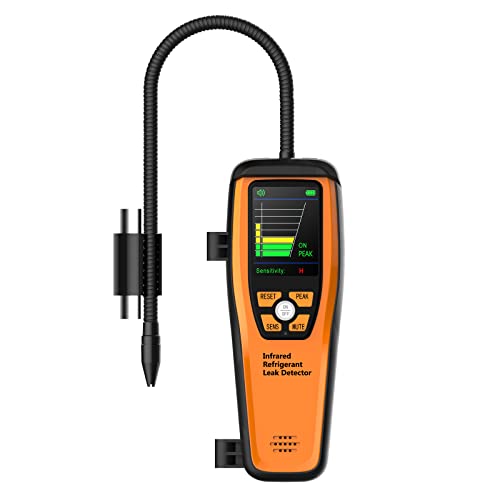
The ILD-200 uses an infrared sensor, offering strong anti‑interference, faster response, and longer service life compared with heated diode models. It detects all halogenated gases, including CFCs, HFCs, HCFCs, HCs, HFOs, and blends like AZ‑50, HP62, and MP39. Maximum sensitivity reaches 0.14 oz/yr. This unit emphasizes stability and accuracy in environments with electrical noise or varied gas concentrations. Best for professional shops that require precise leakage data over long operational periods.
Who it’s best for: technicians needing robust, interference‑resistant readings. Why selected: infrared technology typically delivers better stability in noisy environments and broader gas coverage. Caution: infrared sensors can be more sensitive to environmental factors like temperature, so correct calibration and environment control improves results.
Elitech ILD-100H Heated Diode Sensor Detector

This model features a heated diode sensor for improved accuracy across halogen refrigerants. It includes a TFT screen for clear readability of sensitivities, leakage alerts, and battery levels. Maximum sensitivity is up to 0.1 oz/yr. Because of its digital display and stable sensor, it suits technicians who need straightforward, readable readouts in variable lighting and tight spaces. Best for shop settings where quick visual confirmation matters and where a TFT screen aids rapid interpretation.
Who it’s best for: professionals who prioritize on‑screen clarity and a compact form factor. Why selected: TFT display simplifies operation in dim or bright environments. Caution: lower maximum sensitivity than some infrared or heated diode rivals, so very small leaks may require careful attention.
SENSYX 2‑in‑1 Rechargeable HVAC Detector

The SENSYX SFD201 combines a halogen leak detector with a user‑friendly rechargeable design. It uses a Japan‑made heat dioxide semiconductor sensor for high sensitivity and reliability. It offers high/low sensitivity levels, and a USB‑C charging option, enabling cordless operation for extended use. Best for mobile technicians who need a self-contained, rechargeable unit, especially in repair scenarios where access to power is limited.
Who it’s best for: contractors and DIYers needing cordless operation. Why selected: rechargeable battery adds portability and reduces downtime. Caution: battery life and charging status should be monitored to prevent mid‑job power loss.
VIVOHOME HVAC Freon Leak Detector

The VIVOHOME detector claims universal compatibility with halogenated refrigerants, including HFCs (R134a, R410A, R32), HFOs (R1234yf), CFCs, and HCFCs. It features seven sensitivity levels and auto‑adjusts to gas concentrations with a maximum of 0.21 oz/yr. A distinctive feature is its dual‑color LED work light and a bendable probe of about 7.9 inches for navigating tight spaces. Best for automotive and home HVAC technicians who need Versatile detection plus illumination for dark engine bays.
Who it’s best for: users who benefit from visual illumination in addition to audible alerts. Why selected: flexible probe and LED lighting help pinpoint leaks in cramped or poorly lit areas. Caution: some users may prefer infrared or heated diode sensors for very precise readings in high‑noise environments.
Buying Guide: Key Purchase Considerations
What gas coverage do you need? If you work with a broad range of refrigerants, choose a detector that explicitly lists R22, R134A, R410A, R1234YF, and other halogenated gases. Consider infrared or heated diode sensors if you require higher stability in noisy environments.
How important is accessibility? Long probes and flexible geometries improve leak localization in engines, compressors, and tight compartments. A digital TFT display can simplify reading sensitivities and alerts in bright or dim conditions.
What about power and portability? Rechargeable units are beneficial for field technicians who move between job sites. Always check battery life and charging options (USB‑C, standard batteries) to avoid mid‑job outages.
What is the expected work environment? For urban service shops with ambient electrical noise, infrared detectors offer better anti‑interference. In highly lit or accessory‑dense spaces, a unit with a clear audio/visual indicator is advantageous.
How precise should readings be? For professional diagnostics or compliance checks, look for specifications like maximum sensitivity (0.21 oz/yr or similar) and a proven sensor type (infrared, heated diode, or corona) that matches your accuracy needs.
FAQ
- What is a halogen leak detector used for? It detects leaks of halogen refrigerants in HVAC, automotive AC, and refrigeration systems to identify gas escape points.
- Which detector is best for hard‑to‑reach areas? Detectors with long flexible probes (around 8 inches or more) perform better in tight engine bays and compressors.
- Do infrared sensors offer advantages over heated diode sensors? Infrared sensors tend to be more resistant to interference and can provide stable readings in noisy environments.
- How important is sensitivity level? Higher sensitivity helps detect smaller leaks but may increase nuisance beeps in high‑gas environments; choose a model with adjustable levels to balance sensitivity and noise.
- Should I prioritize a rechargeable detector? Rechargeable units improve mobility for field work, but ensure spare charging options or batteries are available for long days.
- Are all halogen detectors compatible with R1234YF? Most listed models detect R1234YF and common halogen refrigerants, but verify gas coverage in the product specs before purchase.