If you’re heating large pools, a 50,000 BTU class heat pump can extend your swimming season without breaking the bank. This guide highlights five high-capacity options suited for above-ground and in-ground pools, focusing on efficiency, control, and reliability. The best choice depends on pool size, climate, and whether you prefer WiFi control or simple on/off operation. The table below compares the five selected models to help you choose quickly.
Chosen products at a glance
- TURBRO Beluga B50V — 50,000 BTU, up to 15,000 gallons, inverter, WiFi, best for mid- to large-sized residential pools.
- Vidapool 55,000 BTU — strong heating for up to 16,000 gallons, smart control, energy-conscious inverter design.
- WARMBLU H18 — 60,000 BTU, large-capacity up to 21,000 gallons, high COP, corrosion-proof titanium exchanger.
- MICOE 58,000 BTU — robust heating for up to 16,500 gallons, titanium exchanger, app control.
- Varpoolfaye 58,000 BTU — 17,000-gallon capacity, inverter control, tight temperature control.
TURBRO Beluga B50V 50,000 BTU Heat Pump

The TURBRO Beluga B50V is designed to maintain a steady pool temperature rather than creating a hot tub environment. It uses full DC inverter technology to adjust heating power based on ambient conditions and water flow, aiming for temperature stability. It supports up to 52,200 BTU heating capacity with a COP up to 15.9, and it uses a titanium heat exchanger for durability. Best for mid- to large-size residential pools that want reliable heating with smart features.
Who this is best for: homeowners seeking high efficiency and WiFi-enabled control for up to roughly 15,000 gallons. Why chosen: it balances efficiency with a robust inverter system and a strong price/performance ratio. Caution: not intended to turn a pool into a hot tub; expect slower heating in very cold weather if water starts below 60°F.
AQUASTRONG Inverter 55,000 BTU Heat Pump
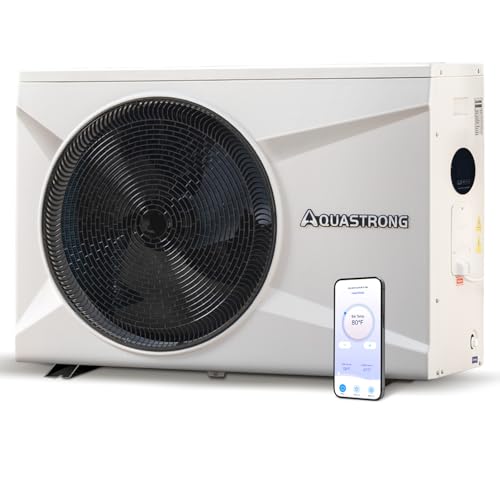
The AQUASTRONG heat pump delivers rapid warming for larger pools, up to 9,000 gallons in some models but scalable with higher BTU units. It features full DC inverter technology delivering an estimated COP near 15.8 and offers remote APP control for temperature and scheduling. Best for large pools needing fast warm-up cycles and flexible remote management. Slight limitation: performance may vary with ambient temperature; in very cold conditions, heating efficiency can decline without proper cover or heat retention.
Vidapool 55,000 BTU Heat Pump

Vidapool’s 55,000 BTU model is built to heat pools up to about 16,000 gallons with energy efficiency in mind. It offers an inverter-based system and smart control via an app, enabling remote temperature adjustments, energy monitoring, and scheduling. Best for large residential pools seeking steady heating with convenient app control; choose this if you value strong BTU output and smart features. Limitation: app reliability can vary by network environment, so local control remains important.
MICOE 58,000 BTU Pool Heat Pump
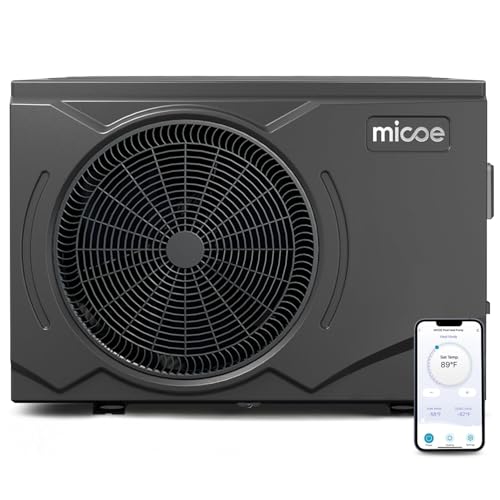
The MICOE model is a high-capacity heater designed for pools up to 16,500 gallons. It uses a titanium heat exchanger for corrosion resistance and supports both heating and cooling ranges via smart app and digital controls. Best for pools that require a robust heat pump with reliable corrosion resistance. Choose this if you want strong heating power with durable components and full app control; caution: installation and space planning should accommodate the larger footprint of 58,000 BTU units.
Varpoolfaye 58,000 BTU Inverter Heat Pump
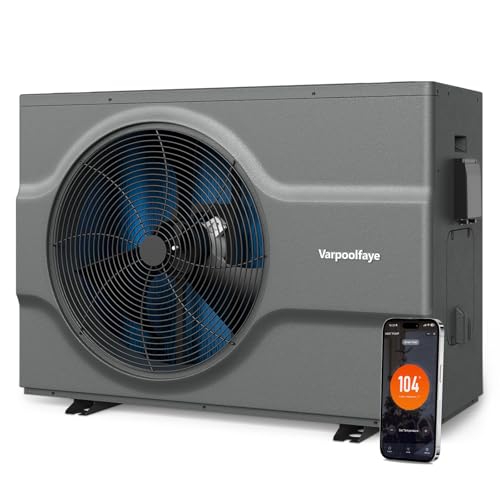
Varpoolfaye offers an 58,000 BTU inverter heat pump designed for up to 17,000 gallons. It provides 46°F–104°F heating and 46°F–82°F cooling with app and touchscreen remote control. Best for users who want precise temperature control and energy savings from inverter technology. Limitation: noise levels and installation space considerations should be reviewed, as larger units require adequate ventilation and placement away from living spaces.
Buying Guide
What size pool do you have? Heat pumps in the 50,000–60,000 BTU range are aimed at large residential pools. If your pool is closer to 15,000 gallons, a 50,000 BTU unit can be sufficient; for 16,000–21,000 gallons, consider 58,000–60,000 BTU models for faster heating and better seasonal extension.
Do you need smart control? If remote access and scheduling matter, prioritize models with integrated mobile apps and WiFi control. Inverter technology adds efficiency, but the availability and reliability of app communication can influence daily use.
What climate conditions affect performance? Inverter heat pumps maintain efficiency across a wide range of ambient temperatures, but very cold weather can slow heating. A pool cover helps retain heat and reduces running costs, especially in shoulder seasons.
What about maintenance and durability? Titanium heat exchangers are a strong indicator of corrosion resistance, especially for saltwater pools. Ensure proper sizing for your pool to avoid overworking the unit, which can affect longevity and efficiency.
Convenience vs. budget: Inverter units typically cost more upfront but save more over time due to higher COPs and adjustable output. For quiet operation, consider models marketed for low-noise performance and place units away from bedrooms or living areas.
FAQ
- What does 50,000 BTU mean for pool heating? It indicates the unit’s warming capacity at peak operation, affecting how quickly a pool reaches the desired temperature.
- Can these heat pumps cool the pool as well? Many models offer a cooling mode in addition to heating, which helps during hot stretches.
- Is inverter technology worth it? Inverter systems modulate power to match demand, improving efficiency and reducing energy waste over traditional fixed-output heaters.
- Do I need a professional to install? Yes. Proper electrical connections, clearance, and refrigerant considerations require a licensed installer for safety and performance.
- Will a heat pump work in very cold climates? Heat pumps lose efficiency as temperatures drop; a pool cover or supplemental heating may be needed in cold months.
- How do I maintain efficiency? Regular cleaning of filters, ensuring proper water flow, and keeping a stable pool temperature help maintain COP and reduce running costs.