Looking for a 50+ gallon air compressor that handles heavy-duty tools and continuous use? This guide highlights five top options that are well-suited for automotive shops, woodworking setups, and professional garages. Each pick balances capacity, reliability, and maintenance needs. The buyers most likely to love these are: shop professionals needing long run times, DIY enthusiasts tackling large projects, and small garages upgrading from smaller portable units.
Below is a quick side-by-side to help you compare core specs at a glance. These selections emphasize vertical or stationary tanks for maximum storage, 60 to 80+ gallon capacities, and oil-lubed or maintenance-light designs where appropriate.
| Product | Tank Size | Max PSI | Motor/Power | Best For |
|---|---|---|---|---|
| Campbell Hausfeld 60 Gallon Vertical | 60 gal | 175 PSI | 3.7 HP | Heavy automotive and shop use |
| DEWALT 60 Gallon Vertical | 60 gal | 155 PSI | 3.7 HP | Durable, professional-grade tasks |
| Ingersoll Rand SS3L3 60 gal | 60 gal | 135 PSI | 3 HP | High-pressure, continuous duty |
| CRAFTSMAN 33 Gallon | 33 gal | 175 PSI | 1.8–2 HP range (oil-free listed) | Compact high PSI for smaller spaces |
| VEVOR 80 Gallon Stationary | 80 gal | 145 PSI | 6.5 HP | Industrial-scale, long run time |
Campbell Hausfeld 60 Gallon Vertical Air Compressor
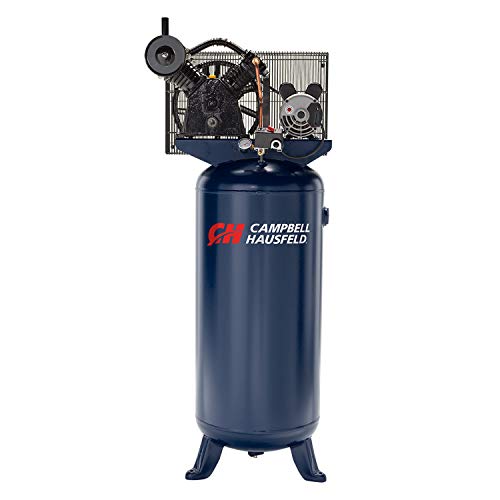
Key features include an oil-lubricated two-stage pump designed for long service life and continuous operation, a high-capacity 60-gallon vertical tank, and a max pressure of 175 PSI. Best for automotive bays, professional shops, and heavy-duty bench work where long runtimes matter. This model excels where high-volume air is repeatedly demanded by automotive tools and sanders. A potential limitation is the taller, vertical footprint that requires adequate clearance for service access and vibration isolation.
Who it’s best for: technicians and garage professionals needing consistent, high-volume air for extended periods. Why selected: its two-stage pump and large tank deliver steady performance with less cycle shutdown for demanding tasks.
DEWALT 60 Gallon Vertical Air Compressor

This 60-gallon, 155 PSI unit uses an oil-lubricated pump for durable performance and uses a space-saving vertical design to fit in tighter shops. It’s a solid choice for professionals who rely on consistent air for impact wrenches, grinders, and spray guns. A caveat is that its high-capacity setup can be heavier and may require a stable mounting or handling plan to manage movement and vibration during operation.
Who it’s best for: professional tradespeople and serious hobbyists who value reliability and a robust oil-lubed system. Why selected: DEWALT’s reputation plus the 155 PSI capacity support frequent tool use with solid duty cycles.
Ingersoll-Rand Ingersoll Rand SS3L3 60 gal

Designed for long life with a cast iron pump and a 60-gallon vertical ASME receiver, this model delivers up to 135 PSI and a high-duty, continuous-use profile. It features auto start/stop controls and easier maintenance with visible oil sight gauges. Best for shops requiring a balance of high durability and moderate air pressure. Limitation: peak PSI is lower than some competitors, which may affect certain high-demand tools.
Who it’s best for: those needing a rugged, long-life compressor for continuous operations. Why selected: proven durability and a straightforward setup that works well in professional environments.
CRAFTSMAN 33 Gallon Vertical

With a 33-gallon tank and 175 PSI maximum, this unit focuses on a compact footprint while still delivering strong PSI for spray painting, nailers, and heavy stapling. It uses an oil-free pump for lower maintenance, making it practical for workshops with limited space. Best for smaller shops or home garages that still need robust PSI capability. Caution: smaller tank means more frequent cycling if you’re running multiple high-demand tools at once.
Who it’s best for: homeowners and small shops needing a strong PSI in a compact form. Why selected: efficient vertical design and maintenance-friendly oil-free pump provide a good balance of performance and practicality.
VEVOR 80 Gallon Stationary

VEVOR’s 80-gallon unit uses a 6.5 HP oil-free motor to generate up to 15.5 SCFM at 90 PSI, with a notably quiet operation at about 86 dB. This model supports extended air supply for industrial manufacturing and larger workshops. It emphasizes speed and efficiency in delivering air to high-demand applications. Limitation: oil-free design reduces maintenance needs but can have different wear characteristics over long use versus oil-lubed pumps.
Who it’s best for: manufacturing settings or hobby shops that require long run times and faster air delivery across multiple tools. Why selected: large tank and high SCFM make it suitable for heavy, continuous tasks with minimized downtime.
Buying Guide: How To Choose A 50+ Gallon Compressor
- Tank size and duty cycle: Larger tanks store more air and reduce pump cycling. For continuous use, aim for 60–80 gallons or more, depending on tool load.
- PSI and CFM needs: High PSI is essential for certain tools, but CFM at a given PSI matters for real performance. Match your primary tools’ requirements.
- Oil-lubed vs oil-free pumps: Oil-lubed pumps last longer under heavy use but require oil maintenance. Oil-free pumps are lower maintenance but may wear differently over time.
- Vertical vs horizontal design: Vertical tanks save floor space and are common in garages; horizontal units can be easier to move and mount in limited setups.
- Noise and vibration: Look for quieter models if your workspace shares space with living areas or offices. Vibration pads can help reduce noise and movement.
- Warranty and serviceability: Consider availability of service centers and parts for long-term reliability in a professional setting.
- Portability vs stationary use: If you need occasional mobility, prioritize wheels or lighter units. For fixed shops, mountable units with solid bases are preferable.
Frequently Asked Questions
- What is the real advantage of a 60+ gallon compressor? It provides greater air storage, longer runtimes between cycles, and supports higher-demand tools for extended periods.
- Do I need an oil-lubed or oil-free pump? Oil-lubed systems are typically more durable under heavy use; oil-free pumps require less maintenance but may need more frequent replacement under extreme workloads.
- Is a higher PSI always better? Not necessarily. PSI matters for certain tools, but CFM at the target PSI determines actual performance for air tools.
- Can a bigger tank save energy? Yes, larger tanks reduce starting and stopping of the pump, which can improve efficiency and tool performance during bursts of use.
- What maintenance is essential? Regular oil checks (if oil-lubed), drain/bleed valves, and inspecting filters or sight gauges help extend life and performance.
- How should I size a compressor for a home workshop? List the most demanding tools you plan to run and choose a unit with at least equivalent or higher SCFM at the required PSI.