For an air compressor rated at 4 CFM at 90 PSI, the Stealth 12-gallon model is best for buyers prioritizing quieter operation, while the CRAFTSMAN 10-gallon model suits users who want a wheeled compressor with a foldable handle. The 8-gallon Generic model offers a lighter, compact option. For more tank reserve, consider NorthStar’s 15-gallon compressor or Campbell Hausfeld’s 26-gallon vertical model. Compare tank size, maximum pressure, noise, and portability before choosing.
| Product | Best for | Tank | Notable feature |
|---|---|---|---|
| Stealth 12 Gallon | Quieter garage use | 12 gallons | 68 dB noise rating |
| CRAFTSMAN 10 Gallon | Portable work areas | 10 gallons | Wheels and folding handle |
| Generic 8 Gallon | Lighter transport | 8 gallons | 42-pound listed weight |
| NorthStar 15 Gallon | More air reserve | 15 gallons | 225 PSI maximum |
| Campbell Hausfeld 26 Gallon | Stationary workshops | 26 gallons | Vertical tank design |
Stealth 12-Gallon Quiet Air Compressor
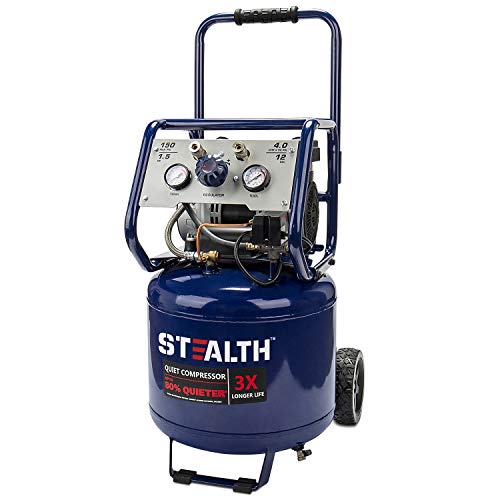
The Stealth is a strong match for buyers who specifically need 4 CFM at 90 PSI and want a quieter compressor for a garage or similar workspace. Its listed output is 4 CFM at 90 PSI and 5 CFM at 40 PSI, with a 12-gallon tank and a maximum pressure of 150 PSI.
It is best for users who value reduced operating noise: the listed level is 68 decibels. The product information also describes a 1.5 HP induction motor, oil-free construction, wheels, and rapid recovery. The stated lifecycle is over 1,000 hours.
Limitation: The 12-gallon tank offers less air storage than the 26-gallon option below. Choose this model for a balance of portability and noise control, not the largest reserve.
CRAFTSMAN 10-Gallon Portable Compressor

This CRAFTSMAN model delivers 4.0 CFM at 90 PSI and 5.0 CFM at 40 PSI. It has a 10-gallon tank, a 150 PSI maximum, and an oil-free design. The listed configuration includes wheels and a foldable handle, which can help when moving or storing it.
It is best for users who need to move a compressor between work areas or tuck it under a workbench. The product information highlights use with large body nailers and says the airflow can support multiple large body nailers simultaneously. Its stated dimensions are 25.6 by 16.3 by 15.3 inches.
Limitation: Its 10-gallon tank stores less air than larger vertical-tank choices. Check each tool’s airflow needs, especially if several tools will run at once.
Generic 8-Gallon Quiet Air Compressor

The 8-gallon model is listed at 4.0 CFM at 90 PSI and 5.2 CFM at 40 PSI, with a maximum pressure of 115 PSI. Its 1.5 HP oil-free pump operates at a listed 1,400 RPM. The product information gives a weight of 42 pounds and a noise level of 70 decibels.
Choose this compressor if portability and a smaller tank are more important than extended air storage. It is described as suitable for tasks such as tire inflation, auto repair, and spray painting. Oil-free operation avoids routine oil changes, according to the listing.
Limitation: Its 115 PSI maximum is lower than the 150 PSI models in this comparison. Confirm that the maximum pressure meets the requirements of your tools.
NorthStar 15-Gallon High-Pressure Compressor

NorthStar lists this model at 4 CFM at 90 PSI, with a 15-gallon vertical steel tank and a maximum pressure of 225 PSI. The listing describes an oil-free pump and dual outlets. It also states that the tank is ASME certified.
This is best for buyers who want a larger tank reserve and higher maximum pressure than a typical 150 PSI compressor. The listing identifies nailers, impacts, and ratchets as examples of tools the tank capacity is intended to support. Oil-free operation is a fit for users seeking to avoid oil checks and changes.
Limitation: The higher maximum PSI does not change the stated airflow of 4 CFM at 90 PSI. Choose based on tool airflow needs as well as pressure and tank capacity.
Campbell Hausfeld 26-Gallon Vertical Compressor

This Campbell Hausfeld compressor delivers 4.0 CFM at 90 PSI and reaches a maximum of 150 PSI. Its 26-gallon vertical tank provides the largest listed capacity in this selection while using a vertical layout intended to conserve floor space. The pump is oil-free.
It is best for a garage or workshop where the compressor can stay in one place and a larger air reserve matters more than easy transport. The manufacturer’s product description identifies inflation and light-to-medium pneumatic tool use as suitable applications.
Limitation: The product details provided do not list wheels or a noise rating. Consider another model if frequent relocation or a specified quiet operating level is important.
Buying Guide: Choosing a 4 CFM at 90 PSI Compressor
Is 4 CFM at 90 PSI enough for your tools?
Check the air consumption requirements listed for each pneumatic tool and compare them with the compressor’s delivered CFM at the required pressure. A 4 CFM rating at 90 PSI is a useful comparison point, but tools that need more airflow may not run continuously at their intended performance. For multiple tools, account for their combined demand.
How much tank capacity do you need?
A larger tank stores more compressed air and can reduce how often the compressor cycles during intermittent tasks. The 8- to 12-gallon models are more compact choices, while the 15- and 26-gallon models provide more storage. Tank size does not replace adequate airflow; use both tank capacity and CFM to compare models.
Should you prioritize maximum PSI or airflow?
Maximum PSI describes the highest pressure the compressor can reach, while CFM at a stated pressure describes airflow at that operating point. For a tool requiring 90 PSI, compare its airflow demand with the compressor’s 90 PSI rating. A higher maximum PSI alone does not mean a compressor supplies more CFM at 90 PSI.
What matters for a home garage?
Noise, footprint, and mobility can be as important as output. The Stealth lists a 68-decibel noise level; the Generic models list 70 decibels. Wheeled designs can be easier to move, while a vertical tank may use less floor space. Confirm the available space and the product’s transport features before buying.
Is an oil-free compressor a good choice?
Oil-free models can reduce routine maintenance because they do not require pump oil checks or changes. All five compressors featured here are described as oil-free. Buyers should still follow the manufacturer’s instructions for operation and maintenance, including any tank care requirements.
Frequently Asked Questions
What does 4 CFM at 90 PSI mean?
It means the compressor is rated to deliver 4 cubic feet of air per minute at a pressure of 90 pounds per square inch.
Is a 4 CFM compressor suitable for impact wrenches?
It depends on the specific wrench’s airflow requirements and how continuously it will be used. Compare the tool’s stated CFM demand with the compressor’s rating at the operating pressure.
Does a larger tank increase CFM?
No. Tank capacity affects stored air, while CFM describes airflow delivery. A larger tank may provide a bigger reserve but does not by itself raise the compressor’s CFM rating.
Which option has the largest tank?
The Campbell Hausfeld model has the largest listed tank in this selection at 26 gallons. It is a vertical, oil-free compressor rated at 4 CFM at 90 PSI.
Which listed compressor has the lowest noise rating?
The Stealth 12-gallon model lists a noise level of 68 decibels. The 8-gallon Generic model lists 70 decibels.