Looking for a reliable 24V RV air conditioner that runs off battery power or an onboard DC system? This guide highlights five top options, each tailored for campers, van lifers, truck sleepers, and off-grid RV setups. The best choice depends on your battery capacity, climate, and whether you need heating, heating and cooling, or ultra-quiet operation. The following picks emphasize efficiency, ease of installation, and suitability for 24V electrical architectures. Suitable buyers include full-time RVers seeking off-grid cooling, weekend campers with limited shore power, and van converters needing compact, low-profile units.
Summary of selected products:
| Product | Brand | Key Benefit |
|---|---|---|
| UAHKPA 24V DC RV AC | UAHKPA | High cooling capacity, robust shell, long runtime on large 24V batteries |
| Outequip 24V Black RV AC | outequip | All-season cooling with integrated heating, convenient controls |
| SleYuYir 24V RV AC Unit | SleYuYir | 10,000 BTU cooling + 3,500 BTU heating, rapid climate control |
| Tyoyfong 10200 BTU 24V RV AC | Tyoyfong | Off-grid capable, high airflow, energy-saving inverter tech |
| Tyoyfong 8500 BTU 24V Roof AC | Tyoyfong | Low profile, efficient cooling and heating, battery-friendly |
UAHKPA 24V DC RV Air Conditioner

Best for users who need strong cooling from a compact 24V system. This unit runs on 24V DC, with a 900-watt compressor and 13,000 BTU (2800 watts) cooling capacity. It also features a sturdy thick-shell design with enhanced heat dissipation. Starting current is around 45A, and the air volume is 450 m³/h. Best for campers, vans, or small RVs relying on sizeable 24V battery banks.
Who it’s best for: off-grid travelers with sufficient battery capacity and desire for reliable, robust cooling. Why selected: high cooling output in a 24V package; solid construction and heat dissipation help sustain performance in hot climates. Limitation: larger starting current may require ample battery and wiring support.
Outequip 24V Black RV Air Conditioner

Designed for 24V mobile DC power, this unit provides 11,000 BTU of cooling and 4,500 BTU of PTC heating. It uses app, remote, and touch panel controls to optimize power reserves while delivering steady airflow. It’s well suited for Class B motorhomes, custom van builds, and semi-truck sleeper cabs. Best for: users who want flexible control options and reliable cooling/heating in a 24V system. Limitation: PTC heating is for small spaces and not a primary heat source in extreme cold.
SleYuYir 24V RV Air Conditioner
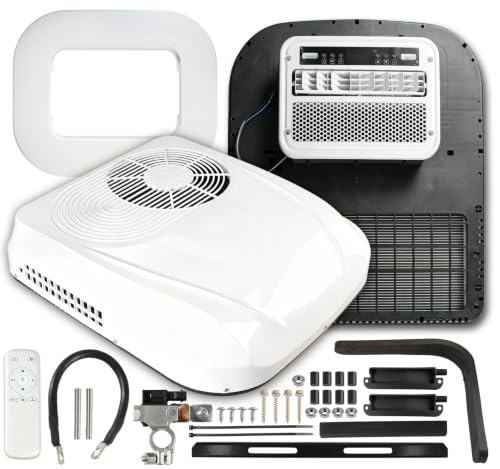
Best for rapid climate control with dual-function heating and cooling. This rooftop unit offers 10,000 BTU cooling and 3,500 BTU heating, designed for quick comfort. It emphasizes a low-profile ABS shell for durability and ease of cleaning. It also includes multi-layer electrical safety features to protect against overvoltage and short circuits. Best for: RVers who want fast cooling/heating and solid protection against electrical issues. Limitation: heating output is smaller than some dedicated heaters and best used for mild seasons.
Tyoyfong 10200 BTU 24V RV AC (Non-Ducted)

Best for true off-grid cooling with long runtime. This unit runs directly from battery power, using a GMCC inverter twin-rotary compressor and a pure sine wave controller for energy efficiency. It delivers 10,000 BTU cooling with high airflow and claims lower energy consumption compared to conventional units. Best for: users with large battery banks aiming to run overnight without shore power. Caution: check battery capacity and inverter compatibility to avoid underpowered setups.
Tyoyfong 8500 BTU 24V Rooftop AC

Best for compact spaces needing efficient cooling and heating. This 8500 BTU unit uses a vortex variable frequency compressor and a four-way valve heat pump for all-season comfort. It’s designed for battery-powered operation with low overall energy use—helpful for small battery setups. Best for: lightweight builds or smaller RVs where weight and space are at a premium. Limitation: lower cooling capacity than larger 10k BTU models, which may matter in very hot climates.
Buying Guide: Key Considerations For 24V RV Air Conditioners
- Power source alignment: Verify your battery capacity and whether you’ll rely on solar, alternator, or shore power. 24V DC units demand compatible wiring and adequate amperage.
- Cooling vs heating needs: If you require all-season comfort, choose units with both cooling BTU and heating BTU specs. Consider heat pump or PTC heating features.
- Installation profile: Low-profile or rooftop models affect aerodynamics, weight, and installation complexity. Measure roof space and weight limits for your RV.
- Energy efficiency: Look for inverter-driven compressors and variable frequency technology to maximize runtime on battery power.
- Electrical protections: Multi-layer protections (overvoltage, undervoltage, short-circuit) reduce risk when powered by batteries or inverters.
- Control options: App, remote, and touch-panel controls offer flexibility for managing power consumption and comfort.
- Durability: ABS shells and weather resistance extend life in sun, rain, and road conditions.
Frequently Asked Questions
- Can a 24V RV air conditioner run directly on a standard 12V battery? No. It requires a 24V system or an appropriate DC-DC converter that supports 24V operation and sufficient current.
- Is heating available with all 24V models? Some units include built-in heating or heat pumps. Check the BTU for heating and whether it’s intended for primary or supplementary heating.
- Do these units require an inverter? Many 24V systems run directly from 24V batteries, minimizing inverter losses. Some setups may use an inverter for shore-power compatibility.
- What battery capacity is recommended for overnight use? Battery capacity depends on BTU, efficiency, and climate. Larger banks (200Ah–400Ah) with good inverter efficiency tend to support longer runtime.
- Are 24V air conditioners noisy? Noise levels vary by model, but many are designed with streamlined housings and vibration-reducing features to minimize sound. Check the manufacturer’s decibel rating when available.
- Can I install these on any RV roof? Most rooftop 24V units are designed for standard RV roofs, but confirm weight, mounting dimensions, and roof integrity with your build.