Answering the search for reliable 150mm extractor fan ducting, this guide highlights five top options that suit DIY setups, workshops, kitchens, and basements. Each product is chosen for compatibility with standard 6″ / 150 mm piping, ease of installation, and practical performance notes. Ideal buyers include homeowners upgrading home ventilation, workshop operators needing robust airflow, and contractors seeking straightforward ducting solutions. Below, compare features, best-use scenarios, and any clear limitations to help you choose confidently.
| Product | Best For | Why Pick | Limitations |
|---|---|---|---|
| Blauberg UK 6″ 150mm 90 Degree Bend | Inline ducting with tight routing | Flame retardant polymer, lightweight, fits standard 6″ / 150 mm systems | 90-degree bend may add resistance in long runs |
| Flexible Ducting Ventilation Pipe (150mm) | General ducting needs and versatile layouts | Unbreakable, durable PVC, maintains shape, good airflow | Flexible ducts can reduce efficiency over long runs |
| GDSTIME AXIAL 15050 Muffin Fan (150mm) | Dedicated 150 mm axial ventilation | Heavy duty build, long lifespan, dual bearing support | Higher noise potential at top speeds |
| VEVOR 6 Inch Exhaust Fan (308 CFM) | High airflow for kitchens and workshops | Strong airflow, energy-efficient, simple on/off | Requires electrical hookup; may be noisy at max |
| Mdeinu 6 Inch Exhaust Fan with Speed Controller | Customizable ventilation for varied spaces | High airflow (358 CFM), adjustable speed, durable metal body | Higher power consumption at faster speeds |
Blauberg UK 6″ 150mm 90 Degree Bend

Best for tight duct routing in 6″ systems. This 90-degree bend is designed to fit standard 150 mm pipes and fittings, aiding smooth airflow around corners. The component is made from flame retardant polymer and is lightweight for quick installation. Use this when you need to negotiate corners or connect to inline fans without adding bulk. Caution: per‑unit bend may introduce small airflow resistance in long duct runs.
Flexible Ducting Ventilation Pipe (150mm)

Best for versatile layouts and quick installations. This flexible 150 mm ducting is described as durable and resilient, designed to hold shape under varying conditions. It’s suitable for general HVAC needs, kitchen hoods, and fume extractor setups where rigid ducting is impractical. Caution: flexible ducts can accumulate kinks if not carefully routed, reducing airflow efficiency in long runs.
GDSTIME AXIAL 15050 Muffin Fan

Best for dedicated 150 mm axial cooling or exhaust needs. With a 120V AC power input and dual ball bearings, this fan is designed for longevity and robust airflow in multiple applications—from cabinets to equipment enclosures. Powered operation and solid construction are advantages. Caution: louder operation at high speeds may be unsuitable for noise-sensitive environments.
VEVOR 6 Inch Exhaust Fan (308 CFM)

Best for high-flow needs in attics, garages, and kitchens. This 6″ exhaust fan delivers strong airflow at 308 CFM with low energy consumption. On/off control makes routine ventilation simple. Caution: higher airflow may require more secure mounting and vibration management on quieter installations.
Mdeinu 6 Inch Exhaust Fan With Speed Controller
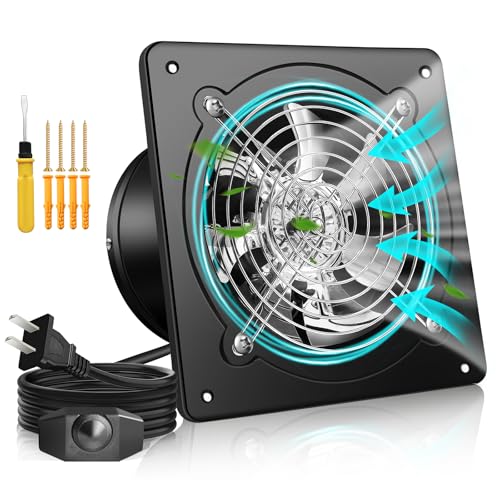
Best for customizable ventilation and larger spaces. This metal-bodied exhaust fan supports an adjustable speed controller, delivering up to 358 CFM at 2600 RPM while consuming about 40W. It suits scenarios requiring variable airflow, such as smoke rooms, workshops, and greenhouses. Caution: higher speeds increase noise; use the controller to balance performance and sound levels.
Buying Guide: Key Considerations For 150mm Ducting
- Airflow requirements: Match CFM or equivalent airflow to space size and activity (kitchens, workshops, basements).
- Duct type: Rigid vs flexible; rigid provides less bend resistance, flexible is easier to route in tight spaces.
- Noise tolerance: Higher CFM fans typically generate more noise; consider dwell time and location when installing.
- Installation compatibility: Ensure 150 mm / 6″ piping compatibility with chosen fan or duct accessory.
- Material durability: Look for flame retardant polymers for bends and metal or robust plastics for fans, depending on environment.
- Power and controls: Decide between simple on/off and adjustable speed controllers for finer airflow management.
- Maintenance and accessibility: Choose components that allow easy cleaning and replacement of parts.
- Environmental conditions: Consider heat, humidity, and potential chemical exposure when selecting ducting materials.
Frequently Asked Questions
- What is the standard size for 150mm extractor ducting?
Answer: The standard size is 150 mm (approximately 6 inches) for many residential and commercial ventilation systems. - Are flexible ducts as effective as rigid ducts?
Answer: Flexible ducts offer easier routing and installation but may add airflow resistance compared to rigid ducts, especially in long runs. - Do 150 mm fans require professional wiring?
Answer: Wiring should meet local electrical codes; if unsure, hire a qualified electrician for connections and mounting. - What should I consider before buying a high-CFM 150 mm fan?
Answer: Assess noise, mounting stability, energy use, and whether the space needs constant or intermittent ventilation. - Can I use a 150 mm fan with a non-standard duct?
Answer: Verify adapter compatibility and ensure a secure, airtight connection with clamps or tape. - Is a speed controller beneficial for a kitchen exhaust?
Answer: Yes, it allows balancing airflow and noise during different cooking activities.