Answering the buyer’s search, this guide highlights top backflow preventers that protect potable water supplies from contamination. Suitable for irrigation pros, facility managers, and homeowners with outdoor water systems, these units guard against back-siphonage and backpressure across a range of pressures and climates. The featured picks emphasize reliability, ease of maintenance, and compatibility with common tubing and unions. A quick buyer’s table below helps compare key options at a glance.
| Product | Best For | Key Benefit |
|---|---|---|
| Febco 765 Series Bronze PV | Industrial plants and large irrigation | Freeze sensor and SentryPlus alert |
| YEE 1″ Backflow Preventer | Residential lawns and gardens | Thick brass with high pressure tolerance |
| Zurn Wilkins 1-350 | Non-potable irrigation systems | Easy line flush and serviceability |
| ONDAQUA 1″ Brass PV | Certified and compliant installations | UPC/ASSE compliant, robust construction |
| Zurn Wilkins 1-720A | Commercial landscapes | Wide installation versatility |
Febco 765 Series Bronze PV Backflow Preventer

The Febco 765 Series Bronze Pressure Vacuum Breaker provides robust backflow protection for potable water against cross-connection hazards. Best for industrial plants or large irrigation setups needing reliable protection and freeze safeguards. It features a plastic bonnet to resist freeze damage, a spring-loaded check valve, air relief valve, and two resilient seated shutoffs with test cocks. Maximum working pressure is 150 psi, with a temperature range of 32°F to 140°F. The unit includes a freeze sensor compatible with SentryPlus Alert technology, useful for facilities monitoring low temperatures.
Who it’s best for: facilities needing integrated freeze detection and alerting to prevent freeze damage and potential contamination. Why selected: it combines standard backflow protection with advanced monitoring, aiding preventive maintenance. Caution: install per local codes and ensure proper alignment for test cocks and connections.
1 Inch Backflow Preventer, Heavy Duty Brass
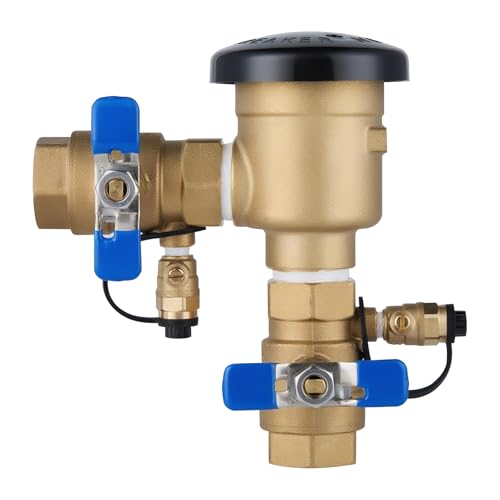
This 1″ backflow preventer uses thickened brass for corrosion and pressure resistance up to 400 PSI. It’s well suited for lawn and garden irrigation, outdoor water lines, and sprinkler systems. Best for residential and small commercial applications seeking strong anti-siphon protection and outdoor durability. It helps prevent back-siphonage and is designed for reliable operation in exposed environments. Caution: ensure compatibility with existing pipe threads and proper sealing to prevent leaks under high pressure.
Zurn Wilkins 1-350 Backflow Preventer

The Zurn Wilkins 1-350 is a classic single-check backflow preventer designed for non-potable systems like irrigation. It includes a flush tool for quick line flushing and an EZSwap removable pressure vessel to reduce repair time. Best for: projects prioritizing straightforward maintenance and efficient serviceability. Caution: if you require dual-check protection, consider a higher-rated model to cover more failure scenarios.
ONDAQUA 1″ Brass Pressure Vacuum Breaker

This 1″ brass PVB combines UP C Certification through IAPMO and ASSE 1020-2020 compliance. It withstands up to 400 PSI, features thickened brass, and includes a flow-direction arrow for faster setup. Best for certified installations requiring reliable compliance and long service life. Caution: ensure proper PTFE tape sealing and correct torque to avoid leaks at high pressure.
Zurn Wilkins 1-720A 1″ Backflow Preventer

The Zurn Wilkins 1-720A is a backflow preventer designed for reliable protection with features like serial number visibility in any orientation and center-line test cocks for versatile installation. Best for: commercial and larger outdoor systems needing flexible commissioning. Caution: verify compatibility with existing piping and test cock access for offline maintenance.
Buying Guide
What type of backflow preventer do I need? For most irrigation and outdoor water systems, a pressure vacuum breaker or double-check style offers reliable anti-siphon protection. Choose PV or double-check based on local codes and water source risk.
What pressure and temperature range are important? Check the maximum working pressure (often 150–400 psi) and operating temperature range. Select a unit matching your system’s pressure and climate to prevent freeze damage and leaks.
Should I prioritize maintenance features? Models with test cocks, flush tools, and serviceable components reduce downtime and repair costs. EZSwap and similar vessels improve efficiency for maintenance crews.
Is certification important? UPC/IAPMO and ASSE standards ensure compliance and safety. Certified products are more reliably supported in code-compliant installations.
What installation considerations matter? Look for clear flow direction markings, compatible end connections (NPT or unions), and compatibility with existing piping. Consider offline testing capabilities for easier compliance checks.
FAQ
- What is a backflow preventer used for? It protects potable water by preventing backflow from irrigation or non-potable lines into the clean water supply.
- What is the difference between a pressure vacuum breaker and a double-check? A PVB primarily prevents backsiphonage, while a double-check offers two barriers and better protection for high-risk systems.
- Do certified backflow preventers require annual testing? Many jurisdictions require periodic testing by a certified technician to verify proper operation.
- Can backflow preventers be installed indoors? Yes, many models are for outdoor use, but some configurations allow indoor installation with appropriate protection from moisture.
- How do I choose between 1″ and larger sizes? Size depends on pipe diameter and flow needs; larger systems require bigger or more robust devices.
- What maintenance is typical? Routine testing, venting of test cocks, and occasional replacement of seals or test fittings keep units reliable.